









What’s at stake as Trump-Petro feud strains the US-Colombia alliance
2025-10-23 07:11:02
Jose Carlos CuetoBBC News Mundo Colombia correspondent

 Getty Images
For decades it was one of Washington’s closest alliances.
Colombia and the United States were united in their fight against drug trafficking, and cooperated closely, with the latter receiving hundreds of millions of dollars in US military aid annually.
But this alliance now appears to be more fragile than ever.
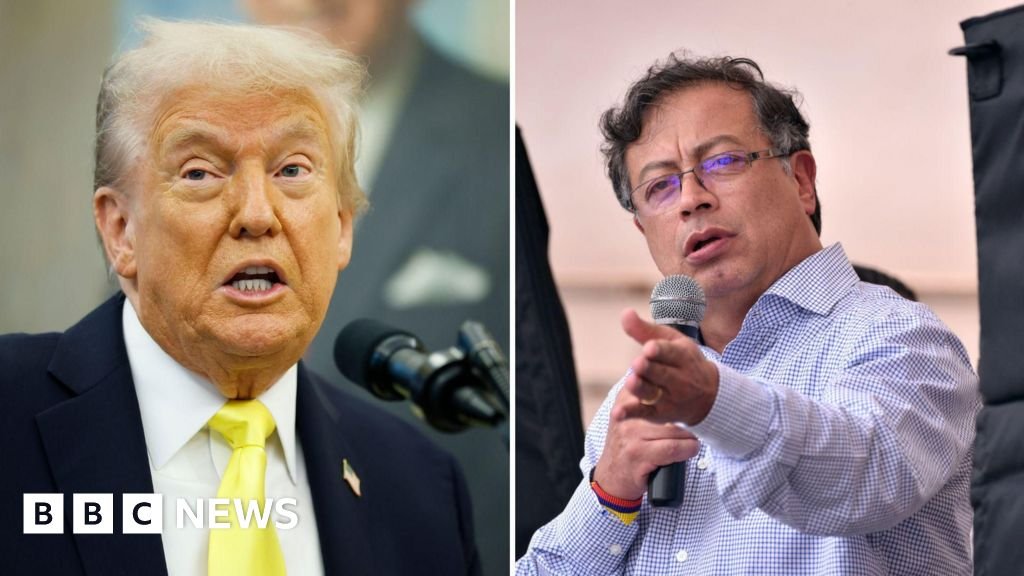
The two countries’ leaders may have a similar style — forceful and not prone to mincing their words — but leftists Gustavo Petro and Donald Trump come from opposite ends of the political spectrum and have clashed repeatedly since Trump returned to the White House in January.
Tensions came to a head on Sunday when Trump accused Petro of encouraging drug production in Colombia and announced the suspension of payments and subsidies to the South American country.
This came after Petro, in turn, accused US officials of killing a Colombian citizen and violating his country’s sovereignty in one of several strikes carried out by the US military against alleged drug ships in the Caribbean since early September.
BBC Mundo spoke to experts who warned that with the alliance at risk, both Colombia and the United States could risk losing while organized crime groups look set to benefit.
The roots of the US-Colombia alliance
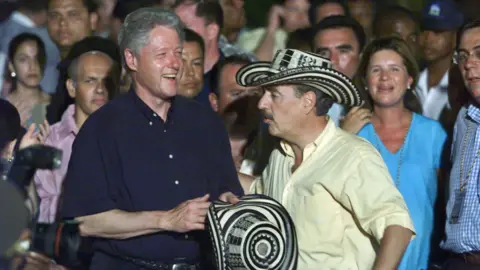
Colombia became one of the main recipients of US aid in the early 2000s, with money going toward Plan Colombia – a US-funded initiative to combat drug trafficking groups, reduce the flow of drugs into the United States, and strengthen Colombian security forces.
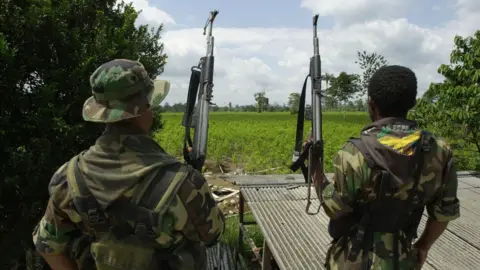
The investment is credited with weakening the FARC armed group, which was at war with the state before it was officially demobilized in 2016.
Since then, US aid has been reduced and has been called into question.
Despite Colombia’s military successes against armed groups, and recent years of relative stability and security, some analysts doubt whether Colombia’s plan has truly solved the drug problem in the long term.
Cocaine production is currently reaching record levels in Colombia, according to researcher Hector Galeano of the Colombia-based Institute for Advanced Social and Cultural Studies in Latin America and the Caribbean.
 Piero Bomboni / Newsmakers
The cultivation of coca, the main ingredient in cocaine, has also reached record levels, although the Colombian government confirms that the rate of crop expansion has been slowing since 2021.
Ironically, the US military campaign in the Caribbean to combat drug trafficking shows that drugs have not been eradicated in the region, and that they remain a priority for Washington.
The strengthening of security forces under Plan Colombia also had side effects.
Paramilitary groups became involved in abuses against civilians, and some demobilized members of these groups later joined the drug trade.
Likewise, the large number of military personnel in the early 2000s produced a large pool of retired young soldiers, some of whom were accused of signing up as mercenaries to fight in foreign conflicts.
 Getty Images
Despite a decline in funding in previous years, US aid to Colombia will still exceed $400m (£300m) in 2024, according to estimates by the US-based research organization Washington Office on Latin America (Wola).
Elizabeth Dickinson, an analyst at the International Crisis Group, told BBC Mundo that Colombia remains “by far the United States’ closest partner in the war against drugs in all of Latin America.”
“It has been nearly three decades of American investment, training, and an unprecedented level of coordination,” Dickinson said.
This alliance has made Colombia and the United States dependent on each other for security. Today, thanks in part to American aid, Colombia has one of the strongest armies in Latin America.
Dickinson explains that Washington, in turn, relies heavily on Bogotá for anti-drug operations.
“About 80% of the intelligence the United States uses to intercept drugs in the Caribbean comes from Colombia.”
Support erosion
Military aid is not the only funding Colombia has received from the United States in recent decades.
With the help of the United States Agency for International Development – Washington’s foreign policy and development assistance agency – Colombia has launched numerous peace and growth projects, especially in poor and conflict-plagued regions.
But earlier this year, the Trump administration announced the effective dismantling of the agency.
Colombia, the largest USAID beneficiary in the region, has seen many of its initiatives canceled and dozens of jobs lost.
“Other sources of aid come from the State Department in the form of civilian and defense funding,” Ms. Dickinson explains.
It says the aid in place today — which Trump appeared to refer to in announcing the cuts — funds Colombia’s communications and intelligence capabilities and equipment, such as helicopters.
“But beyond these financing issues,” she adds, “the seizures, seizures and high-value operations carried out by Colombia are often coordinated with the United States.”
“Not only economic aid has been lost, but also the institutional relationship between the two countries, which are fighting a common threat,” he added.
In mid-September, the United States, for the first time in 30 years, It officially described Colombia as a country that it said had “clearly failed” to meet its obligations to combat drug trafficking – Which opens the door to cutting funding.
However, Washington at the time stopped short of cutting off aid flows, leaving the move as a warning.
But just a month later, the scary cuts appear to be starting to materialize.
Inappropriate timing
The latest spat between Trump and Petro comes at perhaps the most troubling time ever for both administrations.
Petro has been struggling to bring “comprehensive peace” to Colombia, a promise he made during his election campaign, which appears to be unraveling this year due to escalating attacks by armed groups in regions such as Catatumbo, Cauca and Valle del Cauca, which culminated in the assassination of presidential candidate Miguel Uribe Torbay in Bogotá.
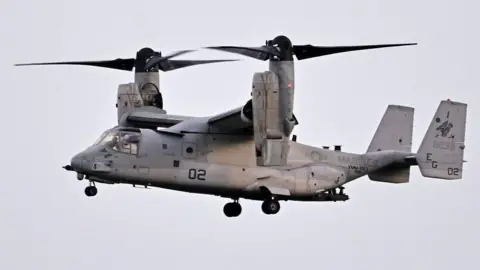
Meanwhile, Trump is waging a controversial crackdown on drug traffickers, and since September, US military ships have attacked suspected drug boats, killing at least 37 people — 32 in strikes carried out in the Caribbean and five more in the first-ever US attacks on two ships in the Pacific, carried out on Wednesday.
This campaign mainly targeted ships that allegedly came from Venezuela, whose president Nicolas Maduro accuses Trump of being the leader of the Cartel of the Suns drug cartel.
Maduro has strongly denied the accusations and said the strikes were aimed at removing him from office.
Legal experts also questioned the legality of the operations and warned that they violate international law.
One of the most vocal critics of the US strikes was President Petro, who called on the United Nations to open a “criminal process” against Trump over the strikes.
 Getty Images
However, both governments appear to need each other, although, in light of recent tensions, they are also moving towards disengagement from each other.
Given their opposing views and outspoken style, it was clear that relations between Petro and Trump “would explode at any moment, especially after the US bombing of boats in the Caribbean,” Galeano says.
In September, Pietro told BBC News Trump’s attacks on boats were an “act of tyranny” and called for US officials to be prosecuted for “murder.”
Last Saturday, he repeated a report by state media RTVC claiming that a Colombian fisherman named Alejandro Carranza was killed in a US boat raid on September 16.
Hours later, Trump announced the suspension of aid and warned that if Petro did not eliminate drug production in Colombia, the United States would do it for him “and it won’t go over well.”
According to the Colombian Ministry of Foreign Affairs, this constitutes a threat to “carry out illegal interference in Colombian territory.”
‘A devastating blow’
Ms. Dickinson describes the deterioration in US-Colombian relations and the aid cuts as a “devastating blow” and warns that they are likely to “weaken the ability of security forces to control armed groups.”
She adds that it is “difficult to understand” why the United States would make such a decision at a time when tensions are rising in the region due to the American deployment in the Caribbean and Trump’s announcement of an “armed conflict” with drug trafficking groups.
“Why confront your closest ally when regional security is already at stake?” he asked. Mrs. Dickinson asks.
Galeano also believes that cracks in the once-strong U.S.-Colombia alliance pose risks for both countries.
“Colombia needs the United States, and the United States needs Colombia,” he explains. “There are military bases used by the United States in Colombia, and even agreements were signed during the Petro administration.”
“And in all of this, the criminal gangs win.”
“While Trump is focusing on the Caribbean, traffickers are smuggling drugs across the Pacific, from Ecuador and Colombia, which are said to be the source of most drugs shipped from South America,” the expert adds.
Since Trump returned to the US presidency in January, friction between his administration and Petro’s has barely subsided.
Within days, the two countries came close to entering into a trade war after Petro returned a flight carrying Colombian deportees from the United States, denouncing the conditions in which they were traveling.
A trade war was quickly averted after some hectic negotiations, but the crisis set the tone for the future.
It reads: “Cooperate or else: Trump’s confrontation with Colombia is a warning to all leaders.”
When Colombian presidential candidate and opposition leader Miguel Uribe Torbay was shot dead in Bogota in early June, US Secretary of State Marco Rubio linked his assassination to “violent leftist rhetoric coming from the highest levels of the Colombian government.”
Weeks later, the two governments summoned their ambassadors for consultations, a step often interpreted in international relations as preceding the severing of bilateral relations.
The envoys remained in place, but Washington has since dealt more severe blows to Petro’s government.
Not only did it officially withdraw Colombia’s accreditation as a partner in the war on drugs, but it also revoked Petro’s entry visa after he led a pro-Palestinian protest in New York while visiting there to attend UN General Assembly meetings.
Following the suspension of US aid and amid the ongoing tense feud between Petro and Trump, many fear the relationship could deteriorate further.
https://ichef.bbci.co.uk/news/1024/branded_news/74b6/live/b89d9640-aebe-11f0-ba75-093eca1ac29b.jpg





إرسال التعليق