











Why Iran should not count on Russia and China
2026-03-02 11:55:35
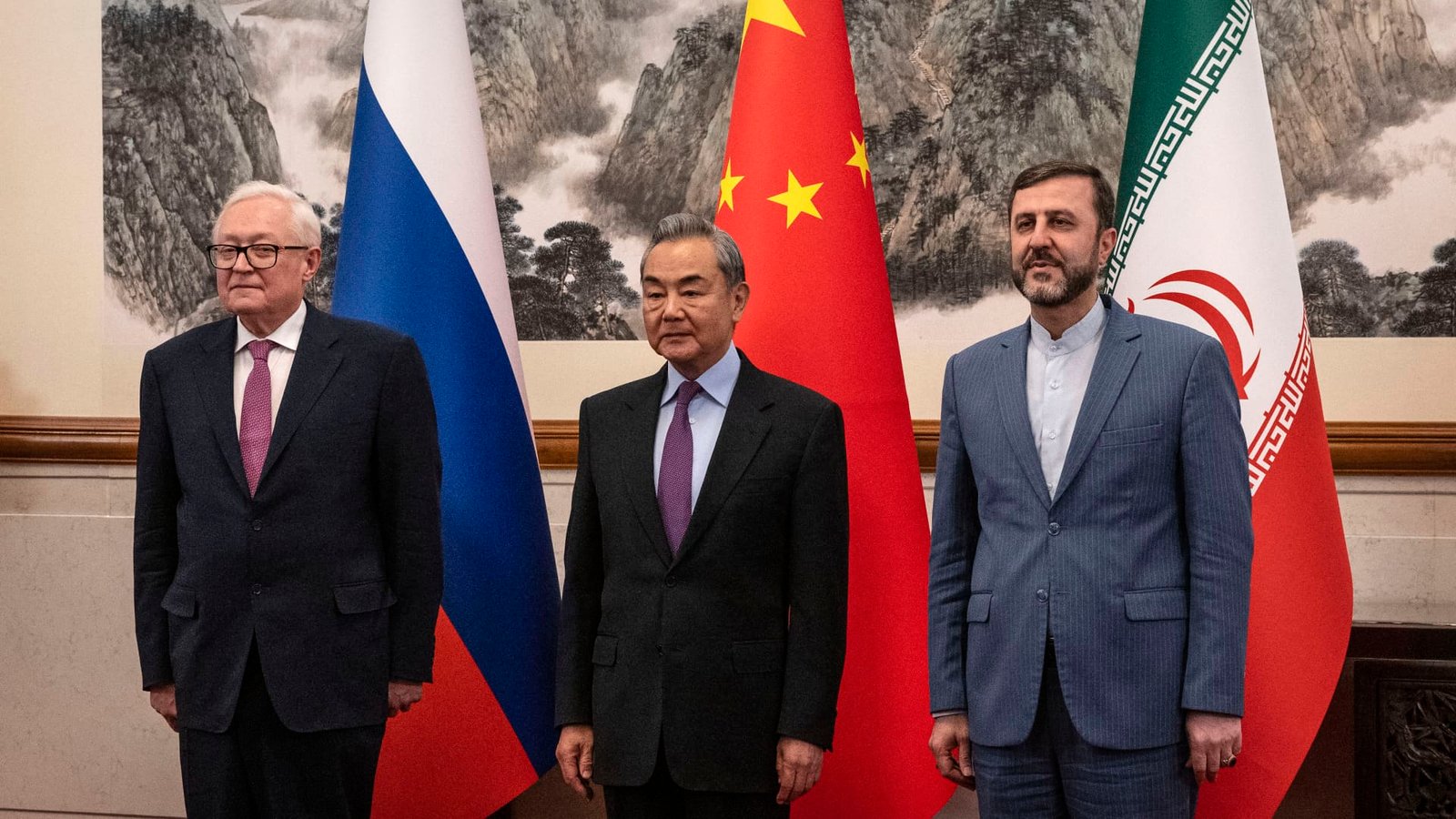
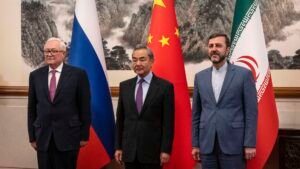
Chinese Foreign Minister Wang Yi (center) welcomes Russian Deputy Foreign Minister Sergei Ryabkov (left) and Iranian Deputy Foreign Minister Kazem Gharibabadi before a meeting on the Iranian nuclear issue at the Diaoyutai State Guesthouse in Beijing on March 14, 2025.
-| AFP | Getty Images
As the US and Israeli strikes enter their third day, Iran’s close allies – Russia and China – have so far responded with muted criticism, which reveals the difficult limits of its “strategic partnerships” with Moscow and Beijing.
Officials from Russia and China condemned the US-led strikes, but stopped short of pledging military or civilian support for Tehran.
In a phone call with his Russian counterpart on Sunday, Chinese Foreign Minister Wang Yi condemned the attacks that claimed the life of Iranian Supreme Leader Ali Khamenei. He said, “It is unacceptable for the United States and Israel to launch attacks against Iran… let alone blatantly assassinate the leader of a sovereign country and incite regime change.”
The Russian Foreign Ministry, implicated in its invasion of Ukraine, issued a statement saying that the “acts of aggression” violate international law and the basic principles of the United Nations Charter, and that they “destabilize the situation in the entire region.”
The two leaders reiterated their leaders’ call for an immediate ceasefire and a return to diplomatic dialogue to resolve disputes. Trump warned on Sunday that the US combat operation in Iran will continue until all objectives are achieved, potentially extending into the next four weeks.
‘Iran has no real ally’
Gabriel Wildau, managing director specializing in China at consultancy Teneo, said the Chinese official statement was “strongly condemning, but beyond this rhetoric, I don’t see the Chinese government taking concrete action to support Tehran.”
“Maintaining détente with the United States remains a strategic priority for the Chinese leadership,” Feldau said, adding that he expects a high-level meeting between US President Donald Trump and Chinese leader Xi Jinping to take place later this month as planned.
Trump and Xi discussed a range of issues, including Iran, during their last phone call on February 4. They are expected to meet during Trump’s visit to China.
“Beijing may seek concessions on issues directly linked to its interests, such as Taiwan and trade, in exchange for its significantly toned-down messaging on Iran,” said Ahmed Aboudah, a fellow at Chatham House, a London-based policy think tank.
Newtankin, a social media account with links to Chinese state media that is widely seen as a mouthpiece for Beijing, wrote on Monday that “Iran has no real ally,” adding that the closest countries would prioritize their own national interests over getting Tehran out of the crisis.
China’s restrained position in supporting Iran militarily is not new.
Last year, Beijing criticized US and Israeli strikes on Iran, but did not provide material support to Tehran, according to Chatham House, a British think tank.
China also supported UN-led economic sanctions against Tehran before the 2015 nuclear deal, and has since moved slowly in directing investment into the Iranian economy, according to the London-based Policy Institute.
Following the seizure of the United States VenezuelaOn January 3, Beijing condemned Venezuelan President Nicolas Maduro’s “blatant use of force” and urged Washington to “stop violating the sovereignty of other countries.” But she did nothing but offer these words of condemnation.
Veldau said China’s responses to US intervention in Venezuela and Iran show that “the strategic partnership with Beijing falls short of a military alliance — or even a guarantee of military support” in the face of “an existential threat from US aggression.”

Russia is watching and waiting
Tehran has been a major strategic, military, economic and trade partner of Moscow in the Middle East in recent years. Iran has become a vital supplier of military drones and missiles to Russia since its full invasion of Ukraine began in 2022.
Russia will fear losing another foothold in the Middle East, because the collapse of the Iranian regime will come after the loss of another regional ally, Syria.After the fall of Bashar al-Assad’s regime In December 2024.
Although the Russian Foreign Ministry condemned the attacks on Iran, neither the Kremlin nor President Vladimir Putin spoke publicly about the situation. CNBC has requested comment from the Kremlin.
In this photo collage distributed by Russian state agency Sputnik, Russian President Vladimir Putin meets with Iranian President Masoud Pezeshkian on the sidelines of the international forum “Interconnectedness of Times and Civilizations – The Basis of Peace and Development” dedicated to the 300th anniversary of the birth of the poet Magtimgoli Faraghi in Ashgabat on October 11, 2024.
Alexander Shcherbak | AFP | Getty Images
Years of grinding war in Ukraine have weakened Russia’s ability to project power beyond its borders, Matt Gerken, chief geopolitical strategist at BCA Research, told CNBC. He added that with its army exhausted and its economy under constant pressure due to Western sanctions, Moscow’s influence in the Middle East is expected to diminish further.
Russia will be watching oil prices closely, as its crude oil sales to China and India help finance its war machine. Oil prices Oil prices rose more than 8% on Sunday evening, as market participants feared that the conflict in Iran could lead to a major disruption to global supplies.
And many OPEC+ countries, including Russia, Announce They announced on Sunday that they will increase production by 206,000 barrels per day from April, as they look to address potential shortages. However, higher oil prices are helping Russia.
“Putin should be thrilled, because anything that raises the price of oil is good for him,” Ellen Wald, president of Transversal Consulting, told CNBC on Monday. He added: “He is certainly able to say: If you cannot get oil from the Gulf, we have great supplies.”

It appears that talks between Ukraine and Russia aimed at ending the four-year-old war have made little progress in recent weeks.
“that it [Putin] “Certainly happy with the situation, although once it is resolved, Trump will certainly turn his eyes to Putin next,” Wald added.
Will Iran fall?
Russia often adopts a “wait and see” approach to global affairs, which does not directly affect its interests. When protests broke out in Iran in late December, Russia did not extend a helping hand. Now, Russia can stand back and watch whether the regime is able to withstand military attacks by the United States and Israel.
Michael McFaul, a Stanford University professor and former US ambassador to Russia, said there is no guarantee that US and Israeli air strikes alone will be enough to lead to regime change.
“Historically, air campaigns do not lead to the overthrow of regimes. I cannot think of a single successful case, even military interventions with boots on the ground.” [tend to fail]He told CNBC.

He added: “We are now bombing military targets that are weapons systems targeting us and against our partners and allies, and we are not destroying the military tools and weapons used to suppress the Iranian people.”
He added: “As of now, it is not entirely clear how this military campaign will now lead to the regime change that President Trump promised the Iranian people.”
— CNBC’s Evelyn Cheng contributed to this story.
https://image.cnbcfm.com/api/v1/image/108271690-1772409830437-gettyimages-2204438991-AFP_37287VV.jpeg?v=1772409866&w=1920&h=1080







إرسال التعليق