












Why China’s youth are not spending
2025-11-11 23:12:23
Stephen McDonnellChina Correspondent

 Benjamin Bigley
China faces a number of economic challenges, and its government wants the next generation of consumers to start spending more for the good of everyone, but it has had no luck convincing them to do so.
Officials say insufficient domestic consumption in much of the community is affecting growth, but recent graduates have more reason than most to be cautious.
Youth unemployment rates have hovered at just under 20% for some time, those with jobs fear they will lose them, and the ongoing real estate crisis may make the prospects of homeownership out of reach, especially in major cities.
This uncertainty is encouraging many of China’s young people to embrace saving instead, and social media has been filled with advice on how people can live on small amounts of money.
“My work is dedicated to a minimalist lifestyle,” one full-time influencer tells the BBC.
The videos posted by the 24-year-old, who goes by the online name Zhang Small Grain of Rice, feature content like her using a bar of regular soap for all her personal cleaning requirements, instead of expensive skin cleansing products.
She can also be seen walking around the shopping areas displaying various bags and clothes which she says are good value because they will last longer.
Companies pay her money to display their wares to her 97,000 followers on Xiaohongshu.
“I hope more people will understand the traps of consumption so they can save. This will reduce their stress and relax them,” she said.
Others focus on eating on a budget.
A 29-year-old who goes by the name Little Grass Floating In Beijing posts videos of himself preparing basic dishes. He says he can eat two meals for just over $1 (76p).
He tells his followers: “I’m just an ordinary person from the countryside. I don’t have a good educational background nor a network of influential contacts, so I have to work hard for a better life.”
He works for an online sales company and claims that his very modest lifestyle has enabled him to save more than $180,000 over 6 years.
Some asked him online if he expects his future wife and children to live the same way and what the ultimate goal is. His answer: “I don’t know.”
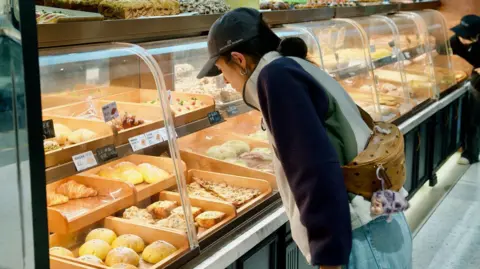
China has gained a reputation as an unstoppable economy, able to survive the turmoil of the pandemic and US President Donald Trump’s trade war.
But analysts say it will face major challenges in the long term if it does not boost domestic spending.
While the United States has a problem with people racking up credit card debt, in China it is the opposite challenge. People already tend to save rather than spend, and this only increases when there are perceptions of difficult times ahead.
The Chinese government has promised for years to increase household consumption, but it still represents only about 39% of GDP, compared to about 60% in most developed countries.
Part of the problem is that today’s youth are more pessimistic than they were in the 1990s and early 2000s.
A young woman in central Beijing told the BBC: “Right now, making money is more important to me. I actually need to expand my sources of income and reduce my costs.”
She adds that, like many other young people, her salary was reduced.
“I changed my job, and it doesn’t pay well. I also don’t know how long this new job will support me in the future. A bad economic environment like this makes people feel frustrated because we don’t earn much. Also, finding a job in the first place is not easy.”
This level of youth unemployment – apart from widespread insecurity – makes it easier for struggling employers to cut wages because workers face a choice between accepting lower wages or diving into a highly competitive labor market.
A young man in his 20s also says that there are low-level jobs available but it is difficult to find decent work in your field of expertise.
“Some of my friends are unemployed, still living at home and looking for work,” he says.
“They had all kinds of majors at the university, from financial services to product sales. The economy is a little stuck at the moment. I hope the situation improves so we can all have a better life.”
How does he assess the chances of this happening soon? “I’m not very optimistic,” he admits.
One of the biggest concerns for new graduates in China is that the country is going through a difficult transition from being a huge producer of cheap goods to a high-tech economy. Many of these new industries do not require that many workers.
Economist George Magnus, a fellow at the China Center at the University of Oxford, follows this phenomenon.
He cites figures from two major recruitment companies in Beijing that show a high level of university graduates, even those with master’s degrees, accepting jobs as delivery drivers.
“It reflects a skills mismatch between the qualifications with which people leave higher education and what exists in terms of labor demand,” he says.
“Of course, it doesn’t help that we’re moving toward becoming a robotics and AI champion, because, at least for now, that’s a job disincentive. The technology isn’t really labor intensive.”

Helena Lofgren has been studying consumption patterns in China for the Swedish Institute of International Affairs, and believes its economy is too dependent on pumping money into favored industries and focusing on selling products abroad at a time of great geopolitical uncertainty.
“People save more than they consume, and we need consumption to make up a larger share of the economy than it does today in China,” she says.
“You have a very export- and investment-oriented economy and what we are seeing now is that these parts are too large for the economy to remain healthy.”
It’s all about economic imbalance. For example, if China suddenly loses a significant amount of export revenue, does it have the tools to counter this by financially empowering its vast domestic population?
Some observers have questioned how serious the Communist Party is in increasing domestic consumption.
In recent decades, the country has prospered thanks to the investment and export model, but this approach now faces a major challenge: deflation. Potential customers often wait for lower prices for goods.
If a young couple wants to buy a new lounge suite, for example, it may make sense for them to wait for a better deal.
The longer they, and many like them, refrain from making large purchases, the more likely companies are to cut prices, causing people to wait longer for a better deal.
Getting cheaper goods may seem like a good idea, but deflation can force companies out of business and hamper overall growth.
This can be countered by somehow arousing optimism among 20 or 30 consumers. It may be helpful to build a better social safety net or increase the minimum wage.
There have been some attempts to do this by offering incentives to replace old cars, home appliances and other items, but they have not raised consumption significantly.
Influencer Zhang says caution about spending is ingrained in her country’s culture.
“My grandfather’s generation was very frugal, very frugal. This is part of the Chinese tradition. That Chinese people are economical is in their bones,” she says.
https://ichef.bbci.co.uk/news/1024/branded_news/c934/live/4f3bd920-beac-11f0-9d0e-d55ceea13692.jpg















إرسال التعليق