











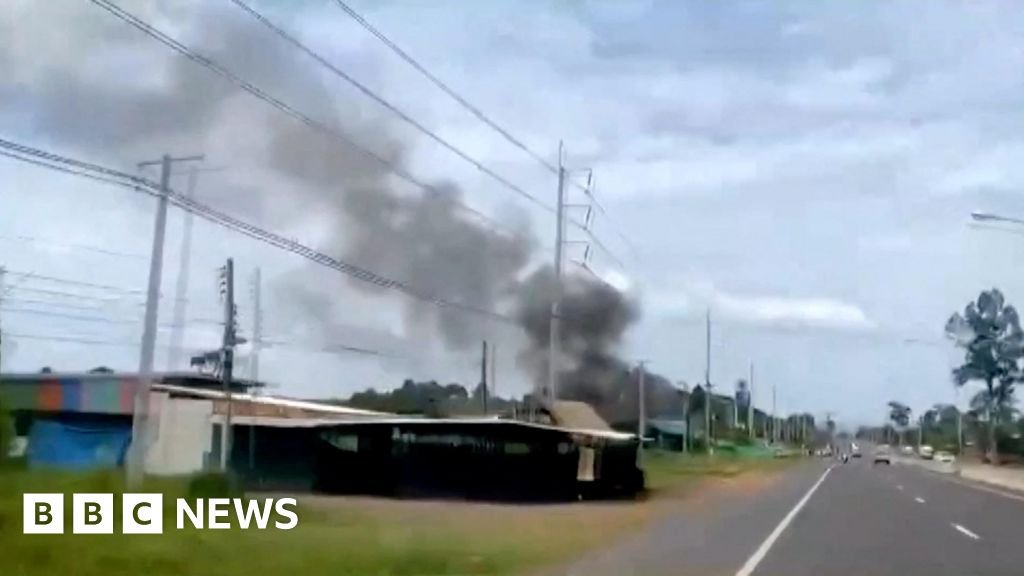
Why are Thailand and Cambodia fighting at the border?
2025-12-09 07:58:35
Flora Drury and Gavin ButlerBBC News

 Reuters
Rising tensions between Thailand and Cambodia have flared again along the border, derailing a fragile ceasefire backed by US President Donald Trump.
At least three Thai soldiers and seven Cambodian civilians have been killed since Monday, with both sides accusing each other of starting the violence.
The clashes, which saw Thailand launch air strikes along the border, are the most serious since a ceasefire was first agreed in July.
On that occasion, at least 48 people were killed, and thousands were displaced after five days of fighting.
Trump then intervened and, with Malaysia’s help, negotiated a ceasefire.
The US President later supervised the signing of what he called the “Kuala Lumpar Peace Agreement” in October. Thailand declined to call it that, instead referring to it as a “joint declaration by the Prime Ministers of Thailand and Cambodia on the outcome of their meeting in Kuala Lumpur.”
Just two weeks later, Thailand suspended the deal. Then, in December, fighting broke out again.
So how did we get here – and where are we headed?
What is behind the tensions?
This is not a recent dispute. In fact, the dispute between Thailand and Cambodia dates back more than a century, when the two countries’ borders were drawn after the French occupation of Cambodia.
Things became officially hostile in 2008, when Cambodia attempted to register an 11th-century temple located in the disputed area as a UNESCO World Heritage Site — a move that was met with strong protest from Thailand.
Over the years, sporadic clashes have occurred, leading to the deaths of soldiers and civilians on both sides.
Tensions recently escalated in May after a Cambodian soldier was killed in a clash. This led to a decline in bilateral relations to their lowest levels in more than a decade.
In the run-up to the first round of fighting in July, the two countries imposed border restrictions on each other. Cambodia banned imports such as fruits and vegetables from Thailand, and also stopped importing energy and internet services.
The two countries have also beefed up troop presence along the border in recent weeks.
Why did they catch fire again?
The two sides gave different accounts of what happened.
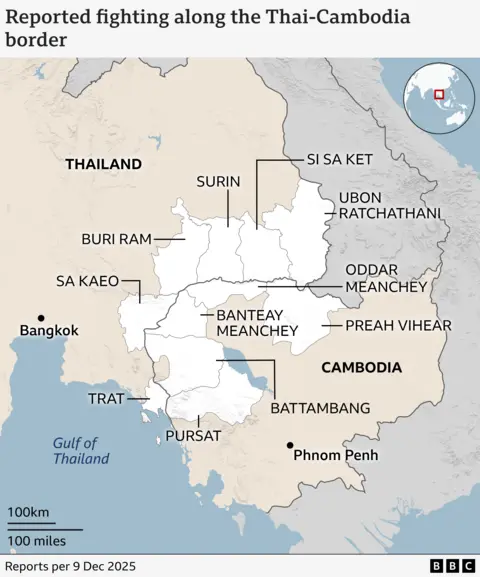
The Thai military said on Monday, December 8, that its forces responded to Cambodian fire in Ubon Ratchathani province in Thailand, which it said killed a Hai soldier.
It added that it launched air strikes on military targets along the disputed border.
The Defense Ministry in Phnom Penh said it was Thai forces that attacked first in Cambodia’s Preah Vihear province. Cambodia also insisted it had not responded.
The next day, the Thai military accused Cambodia of using multiple rocket launcher systems, bomb-dropping drones, and suicide drones against Thai soldiers, with some of the missiles reportedly hitting civilian areas.
It later confirmed that it had carried out more air strikes.
Cambodia also accused Thailand of firing indiscriminately at civilian areas in the border province of Pursat.
What exactly happened in July?
Once again, the two sides gave different accounts of what happened.
Thailand’s National Security Council (NSC) claimed that after 07:30 local time (00:30 GMT) on July 24, the Cambodian military deployed drones to conduct surveillance of Thai forces near the border.
She added that shortly afterwards, members of the Cambodian army carrying rocket-propelled grenades gathered near the border. The National Security Council spokesman claimed that the soldiers of the Thai side tried to negotiate by shouting, but were unsuccessful, adding that the Cambodian soldiers opened fire at around 08:20, forcing the Thai side to retaliate.
Thailand also accused Cambodia of deploying heavy weapons, including BM-21 rocket launchers and artillery, damaging homes and public facilities including a hospital and a petrol station on the Thai side of the border.
Meanwhile, Cambodia claimed that Thai soldiers started the conflict at around 6:30 a.m., when they violated a prior agreement by advancing on a Khmer Hindu temple near the border and placing barbed wire around its base.
Thai soldiers then deployed a drone shortly after 07:00, and fired shots “in the air” around 08:30, according to Mali Suchiata, spokesman for the Cambodian Ministry of National Defence.
At 08:46, Thai soldiers “pre-emptively” opened fire on Cambodian forces, leaving them no choice but to exercise their right to self-defense, the Phnom Penh Post reported, citing Suchiata.
Suchiata also accused Thailand of deploying a large number of troops, using heavy weapons, and carrying out air strikes on Cambodian territory.
But what about the “peace agreement” proposed by Trump?
Thailand had already temporarily suspended the agreement last November, with Thai Prime Minister Anutin Charnvirakul saying that “the security threat… has not actually decreased.”
At the time, Cambodia said it remained committed to the terms of the agreement.
After fighting broke out again in December, Bangkok Foreign Minister Sihasak Phuangkitkyu told the BBC that the ceasefire was “unsuccessful”, adding that “the ball is in Cambodia’s court”.
But former Cambodian Prime Minister Hun Sen said they only returned fire late on Monday to “respect the ceasefire.”
Reuters reported that Trump called on both sides to respect the agreement.
Under the terms of the agreement signed in October, the two countries agreed to withdraw their heavy weapons from the disputed area and form a temporary observer team to monitor them.
The next step was supposed to include the release of 18 Cambodian soldiers detained in Thailand.
Where this leads next is unclear.
Although serious gunfire exchanges have occurred in the past, they subsided relatively quickly.
Back in July, this was the path our correspondent Jonathan Head thought would be taken again.
But he warned that there is a lack of leadership with the strength and confidence to withdraw from this confrontation in both countries at the present time.
You can read more from His analysis from earlier in the year is here.
Is it safe to travel to Thailand and Cambodia?
For those traveling to Thailand, the FCO currently advises against all but essential travel to border areas located within 50 kilometers of the full border with Cambodia.
While for those in Cambodia, it advises against all but essential travel to border areas located within 50 kilometers of the entire border with Thailand.
https://ichef.bbci.co.uk/news/1024/branded_news/dfaa/live/53d6fa40-6877-11f0-af20-030418be2ca5.jpg










إرسال التعليق