










US boat strikes are crimes against humanity, says former ICC prosecutor
2025-11-06 13:32:39
A former ICC prosecutor told the BBC that US air strikes on alleged drug smuggling boats would be treated under international law as crimes against humanity.
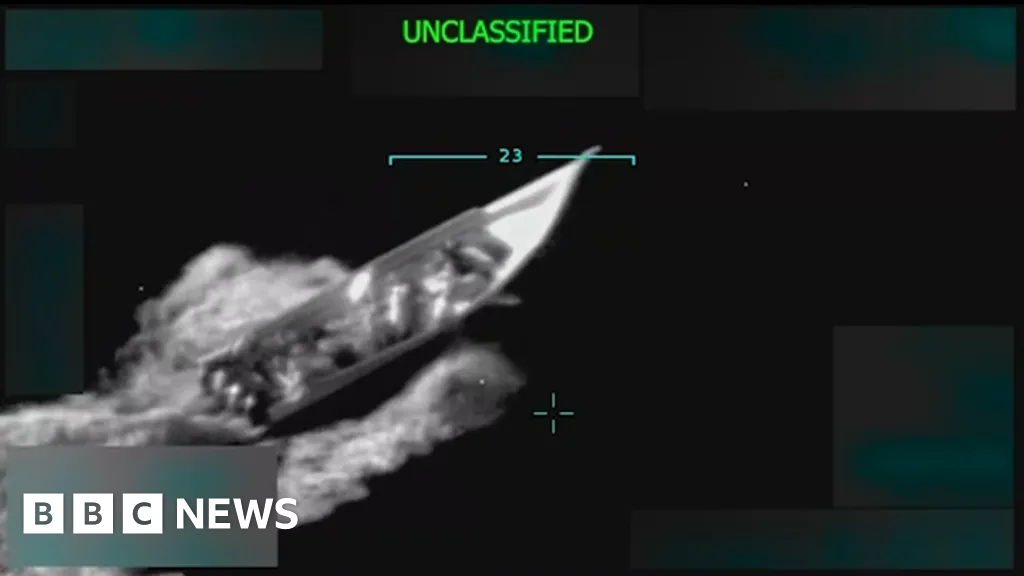
Luis Moreno-Ocampo’s comments come as the Trump administration faces mounting questions about the legality of attacks in the Caribbean Sea and eastern Pacific — which have killed at least 66 people in the past two months.
The administration says it is in a formal armed conflict with South American drug traffickers who bring drugs into the United States.
But Mr. Moreno-Ocampo said the military campaign fell into the category of a systematic, planned attack against civilians during peacetime.
He added that this means that the campaign falls within the category of crimes against humanity.
Commenting on the American accusations against the boat crews, Moreno-Ocampo said, “These are criminals, not soldiers. The criminals are civilians.” He told the BBC: “They are criminals, and we have to do better at investigating them, prosecuting them and controlling them, but not killing people.”
The White House said in response that President Donald Trump acted in accordance with the laws of armed conflict to protect the United States from gangs “trying to bring poison to our shores… and destroy American lives.” She stressed that the International Criminal Court has no jurisdiction over the United States and said that it is a “biased and not serious entity.”
“It is ridiculous that they are now lecturing President Trump and providing cover for evil drug terrorists trying to kill Americans,” said Anna Kelly, deputy White House press secretary.
Moreno Ocampo, a lawyer from Argentina who helped lead the 1985 trial of that country’s former junta, called the strikes an “extremely dangerous” expansion of the president’s powers to use lethal force. He said that in the past, alleged drug boats were stopped and suspects jailed.
He added: “The United States claims that it can kill whomever it wants, and this is a big change because in the past, especially after 1945, the United States was the guarantor of world peace to mainly protect Western values.”
“This is… a very bad trend for the world,” added Moreno-Ocampo, who served as the ICC’s chief prosecutor from 2003 to 2012, opening investigations in seven different countries.
The United States is not a signatory to the Rome Statute that established the International Criminal Court, and it recently imposed sanctions on a number of its judges in response to the court’s investigations into the United States and Israel.
“For me, it is very clear,” Moreno-Ocampo said. “A crime against humanity is a systematic attack against a civilian population, and there is no clarity as to why these people are not civilians, even [though] “They could be criminals… and this is clearly systemic, because President Trump says they planned and organized this, so that should be the charge.”
The Trump administration has sought to justify the boat strikes by saying the United States is engaged in an armed conflict with drug cartel “unlawful combatants” whose actions “constitute an armed attack against the United States,” according to a classified memo submitted to Congress.
In February, it designated eight Latin American organized crime groups as foreign terrorist organizations, naming Tren de Aragua in Venezuela, MS-13 in El Salvador and others. This move represents a significant expansion in the use of foreign terrorist organization designations.
On September 2, Trump announced the first US airstrike on a ship he said was a “drug boat” operated by Tren de Aragua with “a lot of drugs” on board, killing 11 people. Venezuelan President Nicolas Maduro described the attack as a “heinous crime.”
Since then, there have been at least 13 other raids. No evidence of the allegations of drugs on board, nor the substances allegedly involved, have been made public. The BBC has repeatedly asked the Pentagon for the names of the people targeted, but none of them have been revealed.
Meanwhile, a major US military buildup has occurred in the region, leading to speculation about future ground strikes, although Trump has recently downplayed the possibility of any war. Maduro sees this measure as an attempt to remove him from power. Venezuela plays a relatively minor role in the region’s drug trade.
The foreign terrorist organization designation — of the kind the Trump administration is using against drug traffickers — carries no inherent legal weight when it comes to the use of lethal military force, according to Brian Finucane, a former legal counsel at the US State Department. He described the overall US legal position on the strikes as “completely unconvincing.”
He added: “You are faced with a situation that involves intentional killing outside the scope of armed conflict, and we refer to this as murder.”
Republicans in Congress have largely rallied around Trump’s military action. On Wednesday, in a secret meeting, Secretary of State Marco Rubio briefed key lawmakers on the attacks. Afterward, James Risch, a Republican on the Senate Intelligence Committee, said he was “quite satisfied” with its legality.
“I have been fully briefed by management and other members…they have good legal justification for what they are doing,” he said.
“The president should really be congratulated for saving the lives of young Americans,” Risch added.
But many opposition Democrats questioned the legality of the strikes. “What we heard is not enough,” Chuck Schumer, the Senate Democratic leader, said after leaving the press conference. “We need more answers and now I am asking.” [the administration] In order to brief all senators on this issue.”
Under the US Constitution, the authority to declare war rests with Congress. Many previous presidents have ordered military action without congressional approval, but they usually provide legal justifications as required by the 1973 War Powers Resolution, which sets limits on a president’s powers.
After a classified briefing to members of the House Armed Services Committee last Thursday, Democratic Congresswoman Sarah Jacobs said Pentagon officials had not provided a legal justification for what she called “extrajudicial killings where we have no evidence.”
She added that lawmakers were told the strikes targeted alleged trafficking of cocaine rather than fentanyl — even though fentanyl is the substance linked to most illicit drug overdose deaths in the United States.
https://ichef.bbci.co.uk/news/1024/branded_news/88db/live/f65164c0-babd-11f0-906f-6f728cb1342d.png





إرسال التعليق