











Japan restarts world’s largest nuclear power plant
2026-01-21 10:27:48

 Getty Images
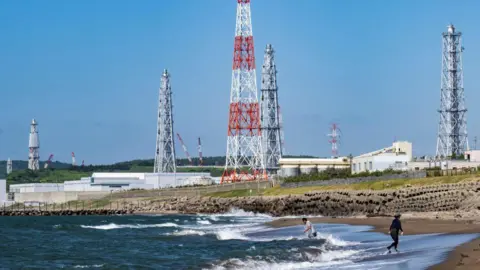
Japan has resumed operation of a reactor at the world’s largest nuclear plant, nearly 15 years after the Fukushima power plant disaster that forced the country to shut down all of its nuclear reactors.
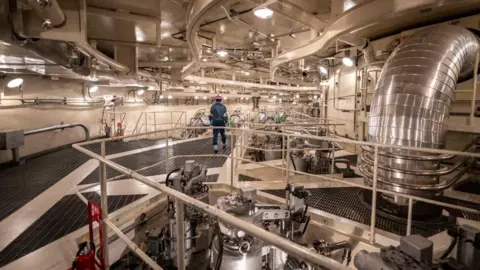
Reactor No. 6 at the Kashiwazaki-Kariwa plant northwest of Tokyo was restarted on Wednesday. Its operation was delayed by one day due to a malfunction in the alarm system, and it is expected to begin commercial operation next month.
This is the latest push in Japan’s nuclear power restart, which still has a long way to go. The seventh reactor is not expected to return to operation until 2030, and the remaining five reactors may be decommissioned. This leaves the plant with much less capacity than it had previously when all seven reactors were in operation: 8.2 gigawatts.
Japan, which has always relied heavily on energy imports, was an early adopter of nuclear power. But these ambitions were thwarted in 2011 by what is now known as one of the worst nuclear disasters in history.
The reactor meltdown at Fukushima Daiichi, caused by the most powerful earthquake ever recorded in Japan, led to a radiation leak. This has traumatized evacuated communities, many of whom have not returned despite official assurances that it is safe to do so.
Critics say Tokyo Electric Power Co., or TEPCO, the plant’s owner, was not prepared, and their and the government’s response was not well-coordinated. An independent government report described what happened as a “man-made disaster” and placed the blame on Tepco, although a court later acquitted three of its executives of negligence.
Yet fear and mistrust fueled popular opposition to nuclear power, leading Japan to suspend its entire fleet of 54 reactors shortly after the Fukushima disaster.
She has now spent the past decade trying to wake up those power plants. Since 2015, it has restarted 15 of the 33 operable reactors. The Kashiwazaki-Kariwa plant is the first plant of its kind owned by TEPCO to be restarted.
Before 2011, nuclear power accounted for roughly 30% of Japan’s electricity, and the country was planning to increase that to 50% by 2030. Japan’s energy plan last year revealed a weaker target: It wants nuclear power to provide 20% of its electricity needs by 2040.
Even this may be difficult.
“A drop on a hot stone.”
Global momentum around nuclear power is growing, with the International Atomic Energy Agency estimating that the world’s nuclear power capacity could double by 2050. In Japan, as of 2023, nuclear power represented only 8.5% of electricity.
Prime Minister Sanae Takaishi, who took office in October, has stressed the importance of nuclear energy for Japan’s energy self-sufficiency. Especially as it expects higher energy demand due to data centers and semiconductor manufacturing.
But the costs of operating nuclear reactors have risen due to new safety checks that require huge investments from companies trying to restart their plants.
“Nuclear power has become a lot more expensive than they thought,” says Koppenburg.
The government could subsidize the costs, or pass them on to consumers – both unpalatable options for Japan’s leaders, who for decades have praised the affordability of nuclear power. The sky-high energy bill could also hurt the government at a time when families are protesting rising costs.
“The government’s hands are tied when it comes to financial support for nuclear power, unless it is prepared to return to one of its main selling points,” says Koppenborg.
“I guess [Japan’s nuclear power revival] “It is a point on a hot stone, because it does not change the bigger picture of the decline of nuclear power in Japan.”
 Getty Images
Beyond the fear of another disaster like Foxohima, a series of scandals have also shaken public confidence.
The Kashiwazaki-Kariwa plant in particular found itself involved in two of them. In 2023, one of its employees lost a batch of documents after placing them on top of his car and then forgetting them there before driving away. In November, it emerged that another person had mishandled confidential documents.
A TEPCO spokesman said the company reported these incidents to the Nuclear Regulatory Authority (NRA), adding that it aims to continue improving security management.
Koppenborg says these findings are a “good sign” for transparency. But they also reveal that “Tepco is struggling to change its ways [and] The way he approaches safety.”
Earlier this month, the NRA suspended its review of the restart of nuclear reactors at Chubu Electric’s Hamaoka plant in central Japan, after it emerged that the company had manipulated earthquake data in its tests. The company apologized, saying: “We will continue to respond faithfully, to the greatest extent possible, to the instructions and directives of the Natural Resources Authority.”
Ni, the former nuclear official, said that while he was “surprised” by the scandal at Hamaoka, he believed the harsh punishment imposed on its operator should prevent other companies from doing the same.
“Energy companies must realize the importance of not doing this [falsify data]He added that the authorities “will reject and punish” the violating companies.
Surviving another Fukushima
What happened in Fukushima turned Japanese public opinion against what was touted as a sustainable and affordable form of energy.
In the weeks following the March 2011 disaster, 44% of Japanese believed the use of nuclear power should be limited, according to a study by the Pew Research Center. This number jumped to 70% by 2012.
Since then, thousands of residents have filed class-action lawsuits against Tepco and the Japanese government, seeking compensation for property damage, emotional distress and health problems allegedly linked to radiation exposure.
In 2023, treated radioactive water will be released from the Fukushima Daiichi nuclear plant It sparked anxiety and anger at home and abroad.
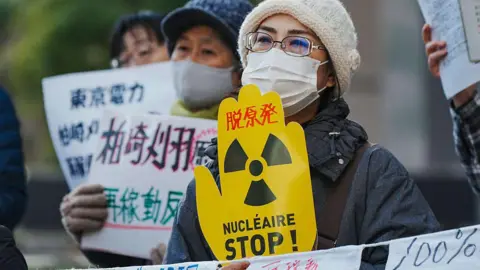
Today, many still oppose the restarting of nuclear plants. In December, hundreds of protesters gathered outside Niigata Prefectural Council, where Kashiwazaki-Kariwa is located, to voice their safety concerns.
“If something happens at the factory, we will be the ones who will suffer the consequences,” one protester told Reuters.
Last week, before Kashiwazaki-Kariwa resumed work, a small crowd gathered in front of Tepco headquarters to protest again.
 Getty Images
Nuclear safety standards have been strengthened after Fukushima. The Nuclear Resources Authority, a ministerial body established in 2012, oversees the restarting of nuclear plants in the country.
In Kashiwazaki-Kariwa, 15 m (49 ft) high seawalls were built to protect against large tsunami waves; Waterproof doors now protect critical equipment in the facility.
“Based on new safety standards, [Japan’s nuclear plants] “We could even survive a similar earthquake and tsunami like the one in 2011,” Hisanori Ni, an assistant professor at the National Graduate Institute of Policy Studies in Tokyo and a former senior nuclear safety official, told the BBC.
But what worries Dr. Florentin Koppenburg, a senior researcher at the Technical University of Munich, is that “they are preparing for the worst of what they have seen in the past but not for what is to come.”
Some experts worry that these policies do not plan adequately to account for rising sea levels due to climate change, or the massive once-in-a-century earthquake Japan expects.
“If the past repeats itself, Japan is very well prepared,” says Koppenburg. “If something really unexpected happens and a tsunami comes in that is larger than expected, we don’t know.”
https://ichef.bbci.co.uk/news/1024/branded_news/d3fa/live/4a8f5190-f692-11f0-a14f-53ca5d79e0d5.jpg














إرسال التعليق