










Jamaica wakes to no electricity and destruction after Hurricane Melissa
2025-10-29 10:34:51
nick davis,Kingston and
Rachel Hagan

 Environmental Protection Agency
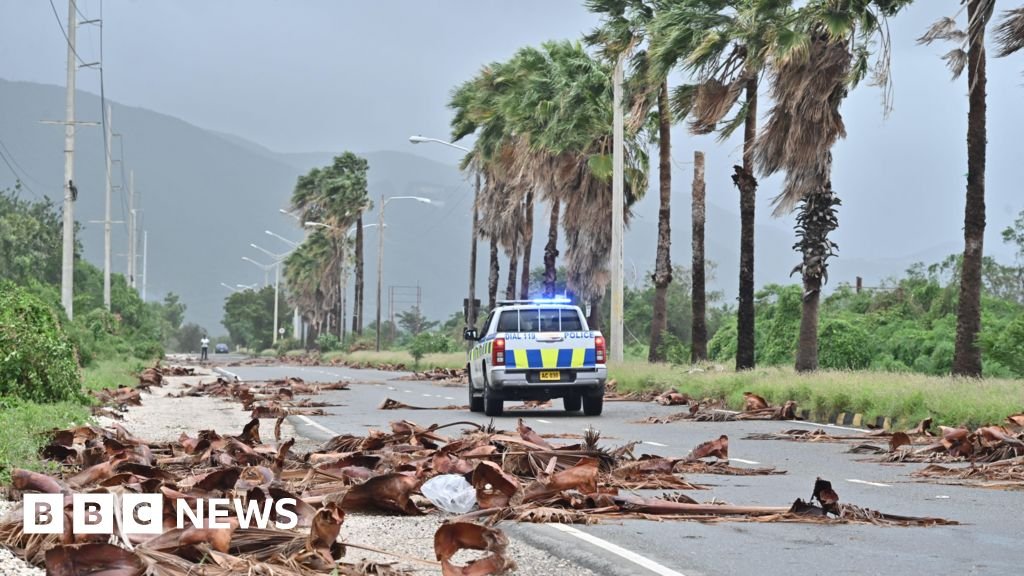
The normal soundtrack that accompanies Jamaican life is silent this morning as many woke up to a power outage.
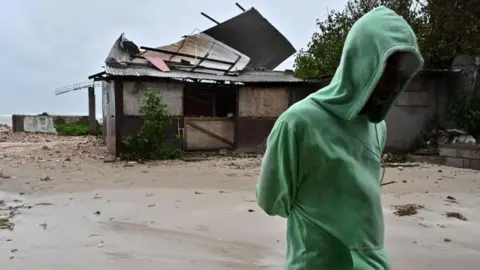
Power was cut off to about three-quarters of the island, much of its western side was under water, and homes were destroyed by strong winds after Hurricane Melissa struck the island with catastrophic force.
As wind and rain raged overnight, one local official said the devastation resembled “an apocalypse movie scene.”
With communications disrupted, the true scale of the disaster remains unknown. Prime Minister Andrew Holness declared the island a “disaster area” late on Tuesday, warning of “devastating impacts” and “extensive damage” to hospitals, homes and businesses.
Although no deaths have been confirmed yet, Montego Bay Mayor Richard Vernon told the BBC that his first mission at dawn would be to “check if everyone is alive.”
 Getty Images
Hurricane Melissa, the strongest storm to hit Jamaica in modern history, swept across the country on Tuesday, leaving a trail of devastation in its wake.
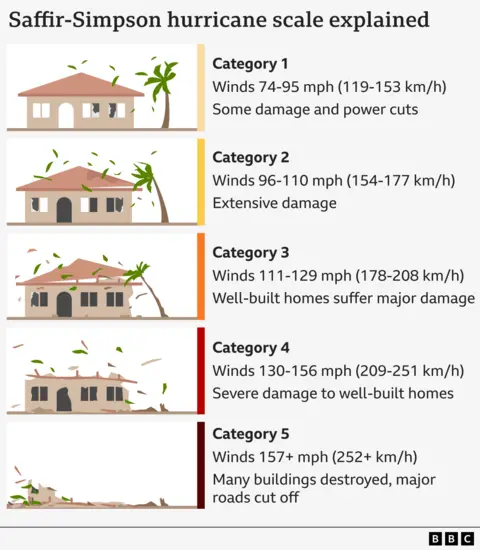
The hurricane’s peak speed reached 298 kilometers per hour (185 mph) – stronger than Hurricane Katrina, which devastated New Orleans in 2005, killing 1,392 people.
“It was like an apocalypse movie scene,” one member of parliament in western Jamaica told Kingston-based journalist Kimonie Francis of the Jamaica Gleaner newspaper.
Francis described the night as “exhausting” and “intense” and marked by wind and heavy rain.
“You have no contact. You can’t talk to the people you normally talk to,” she told the BBC’s Newsday programme.
Throughout Jamaica’s central parishes, floodwaters rose to the roofs of two-story homes, Francis said.
An anonymous woman told the BBC: “There is water flowing through the roof of my house. I am not well.”
While no deaths have been confirmed, Jamaica’s Prime Minister told CNN he fears “there will be some loss of life.” He added that the damage was widespread, hitting hospitals, schools, homes, and businesses.
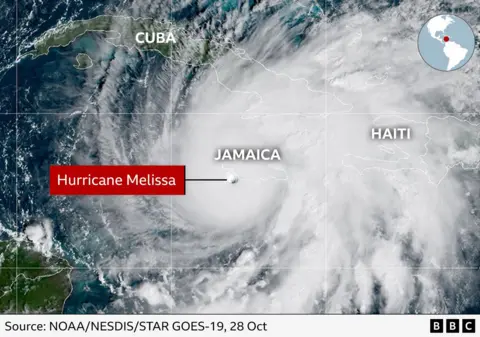
Local Government Minister Desmond McKenzie said on Tuesday afternoon that the south-western parish of St Elizabeth was “under water”, with at least three families trapped in their homes in the Black River community.
He said in a press conference, “Rescue teams are struggling to reach them due to the dangerous conditions.”
Verna Genos was sheltering from the storm in her four-bedroom home in Carlisle Village, St Elizabeth, when the tornado tore off her zinc roof.
The 73-year-old vegetable farmer was at home with her sons and young grandson when the hurricane made landfall over the area.
Verna lost communications due to downed power lines. But her sister, June Powell, who lives in the United Kingdom, spoke to the BBC about what happened.
“She was crying on the phone,” June said, adding: “You’re huddled inside and then you look up and the ceiling is gone. I’ve never heard her like that before – she was crying, ‘We’re all done.'”
She is anxiously waiting for communications networks to return so she can talk to her sister.
St. Elizabeth, known as the breadbasket of Jamaica, produces much of the island’s produce. With crops submerged and fields destroyed, many farmers will struggle to recover financially.
 Environmental Protection Agency
And on the north coast, Montego Bay – the heart of Jamaica’s tourism industry and home to its main airport – will take some time to get back on its feet. This hurricane put a hand around the neck of the Jamaican economy.
Mayor Vernon said the city of Montego was divided into two parts by flood waters. He told BBC Breakfast: “As soon as the winds calmed down, we started to fall torrential rain, leading to massive flooding across the city. One side of the city has now been cut off from the other due to roads being submerged by floodwaters.”
He added that his immediate concern was simple: “verifying whether everyone is alive.”
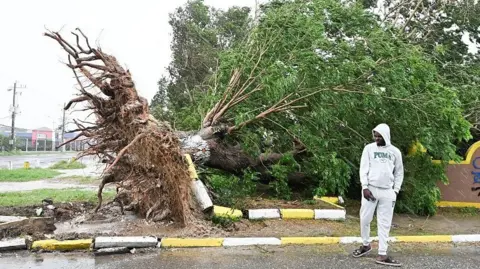
In rural Jamaica, the storm left people in a state of shock. “What I’m seeing now is heavy rain, strong winds, things flying everywhere and trees being uprooted,” said Tamisha Lee, president of the Jamaica Rural Women’s Producers Network. “There’s no electricity. I’m worried and stressed. The damage is going to be huge.”
Meteorologists said Hurricane Melissa intensified at a speed rarely seen, and that its rapid intensification was fueled by abnormally warm Caribbean Sea waters, part of a broader trend linked to climate change.
By the time it hit Jamaica, the storm had reached Category 5 status, with wind gusts strong enough to tear off concrete roofs, uproot trees and knock down power poles.
Health officials even issued a crocodile advisory, warning that floodwaters could push the reptiles into residential areas.
For thousands of tourists stranded on the island, the storm brought terror and uncertainty.
“I’ve never heard anything like this before,” said Bea Chevalier of Cambridge, who traveled to Jamaica with her 15-year-old son on Saturday.
Speaking to BBC Radio 5 live from her darkened hotel room, she said: “The window panes and patio doors were shaking. The doors seemed to be closing, even though they were locked. It was horrific.”
She added: “There is debris everywhere – palm trees, coconuts, branches everywhere. The big palm trees with all their roots up. That’s how strong the wind was.”
On the north coast, Wayne Gibson, a British tourist from Kent on holiday in Ocho Rios with his wife and two teenage daughters, told BBC Radio 4’s Today program they were sheltering in a communal hall.
Kyle Holmes from Bolton, who is visiting Lucia in the North West, described the hotel as a “disaster area” and said he had no idea when they would be able to return home.
Hurricane Melissa had made landfall in Cuba by early Wednesday morning, leaving Jamaica paralyzed and silent. Although it has since weakened to a Category 3 hurricane, it remains strong with wind speeds of over 200 km/h (124 mph).
Jamaica has catastrophic bonds – a type of insurance for the country – which will hopefully allow people to get back on their feet, but the problem is what has been done in the meantime.
Additional reporting by Gabriella Pomeroy
https://ichef.bbci.co.uk/news/1024/branded_news/cffc/live/1c03cf10-b4b4-11f0-b245-913f6e55314b.jpg








إرسال التعليق