











Gaza doctors investigate ‘signs of torture’ on unnamed dead returned by Israel
2025-10-24 05:02:31
Lucy WilliamsonMiddle East correspondent in Jerusalem

 Agence France-Presse
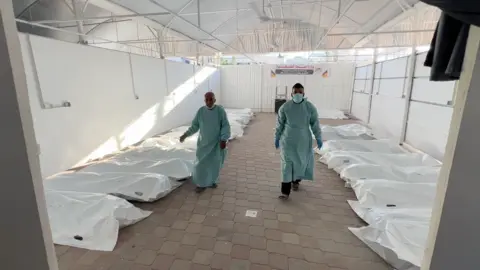
In one room, and without DNA testing facilities or cold storage units of its own, the forensic team at Gaza’s Nasser Hospital faces the challenges brought by peace.
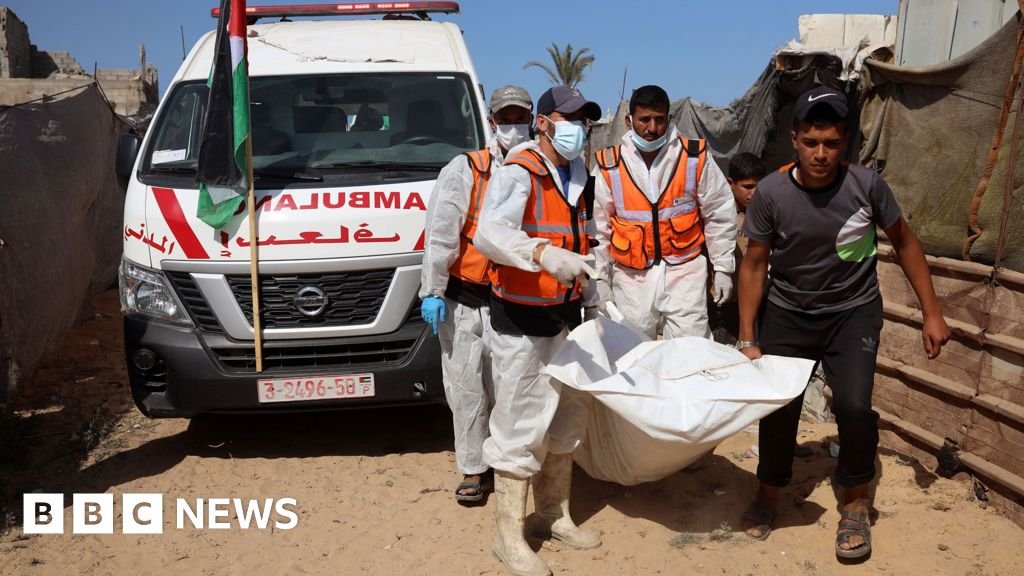
Over the past 11 days, Israeli authorities have returned 195 bodies to Gaza, in exchange for the bodies of 11 Israeli hostages, under the terms of Donald Trump’s ceasefire agreement. Two other bodies were also returned – those of the Tanzanian and the Thai hostages.
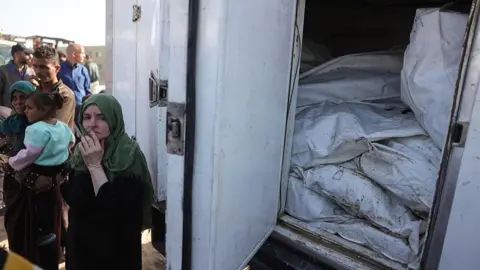
Pictures published by medical authorities in Gaza show some severely decomposed bodies, arriving in civilian clothes or naked except for underwear, and some bearing multiple signs of injury. Many had their wrists tied behind their backs, and doctors say some of the bodies arrived blindfolded or with a piece of cloth tied around their necks.
The forensic team at Nasser Hospital is working with almost no resources to answer major questions about torture, ill-treatment and identity.
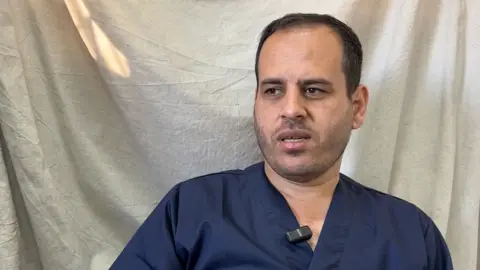
The head of the unit, Dr. Ahmed Dhair, said that one of the biggest constraints they face is the lack of space for cold storage. Bodies arrive in Gaza completely frozen and can take several days to thaw, ruling out even basic identification methods such as dental history, let alone a deeper investigation or autopsy.
“The situation is very difficult,” he said. “If we wait for the bodies to thaw, rapid decomposition begins almost immediately, putting us in an impossible situation [because] We lose the ability to properly examine the remains. “So the most effective way is to take samples and document the condition of the bodies as they are.”
The BBC viewed dozens of photos of bodies, many of which were shared by health authorities in Gaza, while other colleagues on the ground took other photos.
We spoke to many involved in examining bodies in Gaza, as well as families of missing persons, human rights groups, the Israeli military and prison authorities.
We also spoke to three forensic experts from outside the region, including one who specializes in torture, to educate ourselves about the medical processes involved in this type of investigation – and they all agreed that there were questions that were difficult to answer without an autopsy.
Dr. Alaa Al-Astal, a member of the forensic team at Nasser Hospital, said that some of the bodies that arrived there showed “traces of torture,” such as bruises and marks of beating on the wrists and ankles.
He added: “There were very horrific cases, where the restriction was so tight that blood circulation was cut off to the hands, which led to tissue damage and visible pressure marks around the wrists and ankles.”
“Even around the eyes, when the blindfold was removed, you could see deep grooves – imagine how much force that took. The pressure left actual marks where the blindfold had been attached.”
Dr. Al-Astal also pointed out that the loose clothing tied around the necks of some of the bodies needs further investigation.
“In one case, there was a groove around the neck,” he added. “To determine whether death was due to hanging or strangulation, we needed to perform an autopsy, but since the body was frozen, an autopsy was not performed.”
Sameh Yassin Hamad, a member of the Hamas-run government committee responsible for receiving the bodies, said that there were traces of bruises and blood seepage, indicating that the bodies had been severely beaten before their death. He also said that some of them had stab wounds in the chest or face.
Some of the images we’ve seen of the unit clearly show deep gaps or cable ties held tightly to the wrists, arms, and ankles. One of the photos appears to show bruises and scratches that would confirm that the bands were used when the person was still alive.
The other bodies showed only deep indentations, meaning an autopsy would be needed to determine whether the ligatures were used before or after death. Cable ties are sometimes used when transporting bodies in Israel.
When we asked the Israeli army about the evidence we collected, it said that it operates strictly in accordance with international law.
We showed the images we obtained to outside forensic experts. The photos represent a small portion of the bodies transported by the Red Cross to Gaza.
The three experts said some signs raised questions about what happened, but it was difficult to reach concrete conclusions about abuse or torture without an autopsy.
“What is happening in Gaza is an international forensic emergency,” said Michael Polanin, a forensic expert and professor at the University of Toronto. “Based on images like this, there is a need to perform a full medical autopsy on the bodies. We need to know the truth behind how the deaths occurred, and the only way to know the truth is to perform an autopsy.”
But even with limited forensic data, doctors at Nasser Hospital say the routine handcuffing of the wrists behind the body rather than the front, as well as the marks observed on the extremities, indicate torture.
Dr. Dhair told us: “When a person is naked, with his hands tied behind his back, and clear signs of restraint on his wrists and ankles, this indicates that he died in this position.” “This is a violation of international law.”
There is strong evidence indicating widespread violations of detainees – including civilians – in Israeli prisons in the months following the start of the war in October 2023, particularly at the military facility at Sde Teman.
“At least in the first eight months of the war, detainees from Gaza were shackled behind their backs, and had their eyes covered, 24 hours a day, 7 days a week, for months,” said Naji Abbas, head of the Prisoners and Detainees Program at the Israeli human rights organization Physicians for Human Rights (PHRI).
“We know that people have had serious infections on their skin, hands and legs because of the handcuffs.”
We spoke to several people who have worked at Sde Timan over the past two years, who confirmed that detainees were handcuffed and shackled – even while undergoing medical treatment, including surgery.
One of the paramedics who worked there said that he campaigned for the removal of the handcuffs, and that the treatment of detainees there was considered “dehumanization.”
But many of those detained during the Gaza war are held as unlawful combatants, without charge.
One of the complications that doctors at Nasser Hospital now face is determining which of the returned bodies are Hamas fighters killed in fighting, which are civilians and which are detainees who died in Israeli prisons.
Some of the bodies returned by Israel are still wearing bandanas or military boots carried by Hamas, but doctors say most are either naked or in civilian clothes, making it difficult to discern their role, explain their injuries, and assess human rights violations.
The photos seen by the BBC mostly show naked or decomposing bodies. One person, dressed in civilian clothes and wearing sneakers, suffered what officials say were two small bullet wounds to his back.
 Agence France-Presse
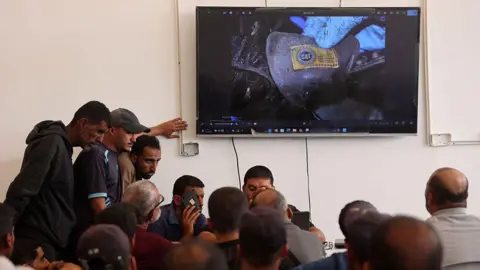
Sameh Yassin Hamad, of the Gaza Forensic Medicine Committee, said that Israel had returned the identities of only six of the 195 bodies it had returned – and five of those names turned out to be wrong.
Dr. Dhair said: “Since these bodies were being held by the Israeli authorities, they will have complete data on them.” “But they did not share this information with us through the Red Cross. They sent us DNA files for about half of the total number of dead, but we did not receive any details about the dates or circumstances of death, or the time or place of detention.”
We asked the IDF about the details in this report, including the shocking allegations made by the Gaza forensics team that Israel removed fingers and toes from bodies for DNA testing.
The Israeli army said that “all the bodies returned so far are fighters inside the Gaza Strip.” She denied linking any bodies before her release.
Israeli Prime Minister’s Office spokeswoman Shosh Bedrosian on Wednesday called reports from Gaza “mere efforts to smear Israel” and suggested the media should instead focus on the experience of Israeli hostages.
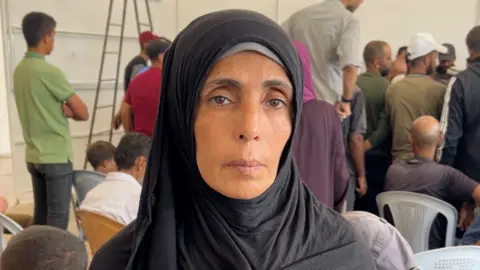
As families of the missing gather at the hospital gates, Dr. Dhair and his staff are under intense pressure to identify the dead and provide answers about what happened to them.
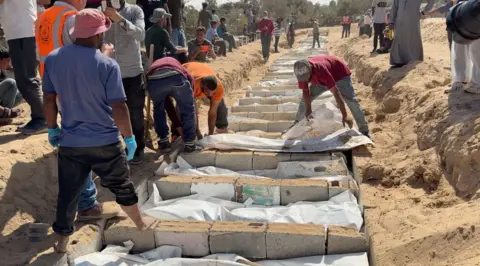
So far, only about 50 bodies have been positively identified, most by basic details such as height, age and obvious previous injuries. Another 54, unidentified and unclaimed, were buried due to extreme pressure on space in the unit.
Several families of the missing attended the burial of the unidentified dead this week, just in case one of them was one of them.
“Honestly, it’s difficult to bury a body when you don’t know if it’s the right one or not,” said Rami Al-Farea, who is still searching for his cousin.
“If there is [DNA] “For the test, we will know where he is – yes or no,” said Howaida Hamad, looking for her nephew. “And my sister will know whether the person we are burying is really her son or not.”
Donald Trump’s ceasefire agreement brought some relief to Gaza, but little closure for the families of most of the missing, resulting in a body being buried in place of a brother, husband or son.
Correction October 24, 2025: An earlier version of this story said the bodies of 13 Israeli hostages had been returned. This number was revised to 11 Israeli bodies, in addition to a Tanzanian and a Thai body.
https://ichef.bbci.co.uk/news/1024/branded_news/307f/live/9f3cfa50-b0b8-11f0-aa13-0b0479f6f42a.jpg










إرسال التعليق