











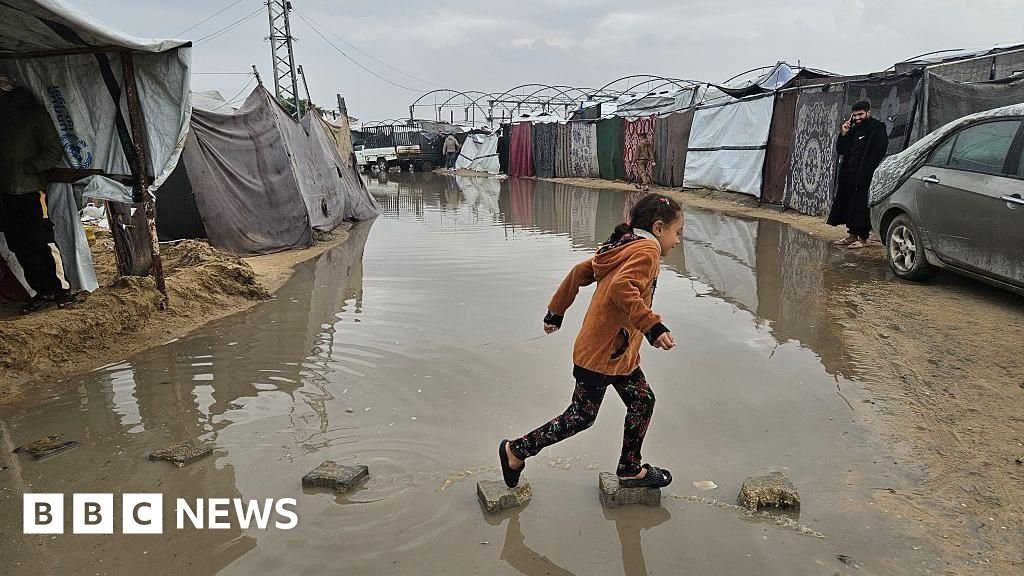
Flood misery for Gazans awaiting next stage of peace plan
2025-12-12 05:43:02
Lucy WilliamsonMiddle East correspondent in Jerusalem

 Anatolia via Getty Images
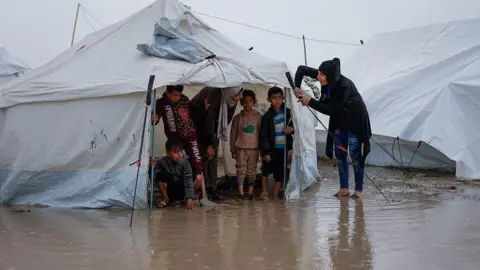
The United Nations says that more than 800,000 Gazans are at risk of flooding, with a strong winter storm sweeping the Strip.
Heavy rains have already flooded the camps, causing many buildings to collapse.
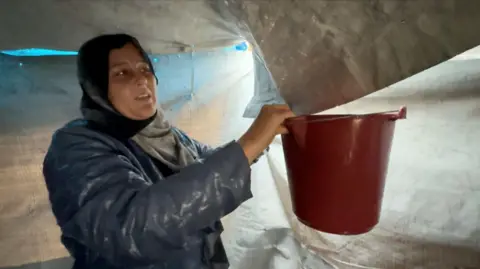
A steady stream of water flows through the openings of the tent Ghadeer Al-Adham shares with her husband and six children in Gaza City. Her family is still displaced after the war, waiting for reconstruction to begin.
“Here we are living a life of humiliation,” she told the BBC. “We want caravans. We want to rebuild our homes. We long for concrete to keep us warm. Every day I sit and cry for my children.”
Two months after a US-imposed ceasefire, Gaza remains stuck in the first phase of Donald Trump’s peace plan – its territory divided between the warring parties, and its population still displaced and surrounded by rubble.
Sticking point
Plans for new homes – and a new government – remain frozen in the next phase of Donald Trump’s peace deal, as the search continues for the last remaining Israeli hostage, Ran Givli.
Israeli Prime Minister Benjamin Netanyahu has insisted that Hamas must return all Israeli hostages – living and dead – before the two sides move to the next, more difficult phase of the peace agreement.
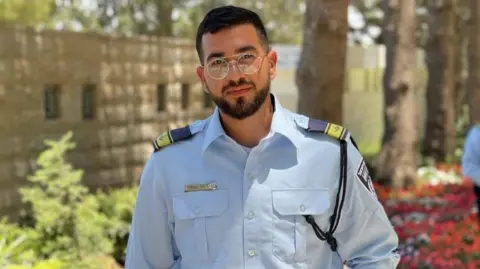
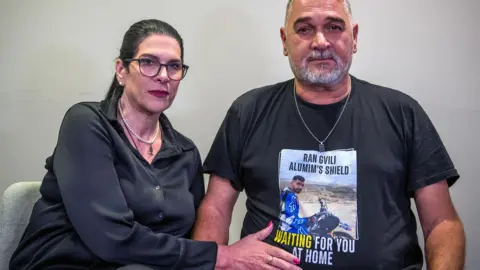
But numerous searches in the ruins of Gaza have so far turned up no trace of him. Gevili was captured during the Hamas attacks on October 7 – a police officer recovering from a broken shoulder who went to defend nearby Kibbutz Alumim.
 charity
His parents, Talik and Itzik, were told last year that he did not survive.
Their path to their home in Mitar, southern Israel, is lined with banners praising it, and yellow flags flutter along it to commemorate the Israeli hostages.
“They stole our child, they stole him,” his mother, Talik, told me.
“They know where he is,” Itzik said. “They’re just trying to hide it or keep it in. They’re just playing.”[ing] “With us.”
They believe that Hamas wants to keep their son as an insurance policy against future negotiations, after all the other hostages, living and dead, are returned.
In response, a Hamas official told the BBC that their claims were incorrect, and that Israel was trying to avoid implementing the agreement.
But with no sign of Givelli’s body, and pressure from Washington mounting, his parents say they are counting on Israel’s leaders not taking action before their son is found.
“Everyone in Israel[‘s] The government tells us: No, we will not move to level two until Ran returns. “This is their promise,” Talic said.
Many in Israel believe it will be politically difficult for Netanyahu to implement the next steps in the deal, including withdrawing Israeli forces to the Gaza perimeter, if even a single hostage is still missing in Gaza.
Time is “running out”
Both Israel and Hamas face difficult concessions in the next phase of the deal. For Hamas, this means handing over weapons and power. For Israel, handing security over to an international stabilization force.
That’s also why leaders on both sides may be hesitant, says retired Gen. Israel Ziv, the former head of Israel’s Military Operations Directorate.
“Israel and Hamas share the same interests in not moving so quickly to the second phase,” he told me. “Hamas does not want to lose control, and the Israeli side also prefers for political reasons to remain in Gaza, as no one wants to explain to its base that it has to withdraw.”
He says that only Trump can move both sides forward, and that time is running out.
He added, “By waiting, I think we may miss the opportunity because Hamas is reorganizing itself.” [its] He explained: “The force is returning. We have to take a deep breath and move forward with this plan, because remaining in the situation as it is is the worst scenario.”
The disarmament of Hamas – as accepted by both parties – is seen as the first major obstacle. Without this, it is unlikely that any foreign country will send forces to secure the Strip, and the reconstruction process in Hamas-controlled areas is unlikely to begin.
Earlier this week, Netanyahu indicated that he was skeptical about the ability of foreign countries to complete the task in Israel’s place.
He said, “Our friends in America want to try to form an international force to undertake this mission.” He added: “We know that there are certain tasks that this force can perform. I do not want to go into details. They cannot do everything, and perhaps they cannot do the main thing, but we will see.”
Trump is eager to move quickly
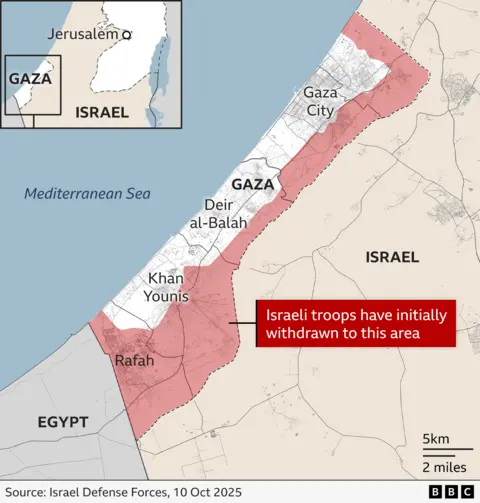
Gaza is currently divided into two parts by the so-called Yellow Line, which defines the boundaries of Israeli forces under the first phase of the ceasefire agreement.
The IDF Chief of Staff recently referred to this line as a “new border line,” sparking accusations that Israel is signaling its intention to remain there long-term.
Key issues, including how to disarm Hamas, are scheduled to be discussed at a meeting between the Israeli prime minister and Donald Trump in Florida later this month.
The US president – who has already brokered a ceasefire in Gaza and pushed his peace plan through the UN Security Council – has been vocal about his desire to move the process forward.
He told reporters this week that he would announce membership of the newly established Gaza Peace Council early next year. “It will be one of the most legendary paintings ever… everyone wants to be in it,” he said.
 Getty Images
There are also widespread reports that Israel, under pressure from Washington, has begun work to clear the rubble, in preparation for a new temporary housing project in the Israeli-controlled Rafah area, south of the Strip.
The new housing could reportedly provide shelter to tens of thousands of Gazans, provided they are willing to cross into Israeli-controlled areas and undergo verification checks for any links to Hamas.
Some see this as part of a plan to attract Gazans to areas controlled by Israel, in order to isolate Hamas. A small number of people have already crossed into these areas, into the camps set up there by Israeli-backed armed groups.
But many Gazans – even those who want to replace Hamas – say they refuse to live under Israeli control.
It is a glimpse of an alternative future for Gaza, if this second phase of the Trump plan fails; A future in which Gaza, already divided, becomes even more divided.
https://ichef.bbci.co.uk/news/1024/branded_news/48cf/live/9b017dc0-d6bb-11f0-9d57-f5bf64d847f4.jpg











إرسال التعليق