








el-Fasher hospital worker describes ‘state of terror’ before fleeing alleged massacre
2025-11-11 17:17:34
Barbara Plett Asher,Africa correspondent and
Muhammad Zakaria
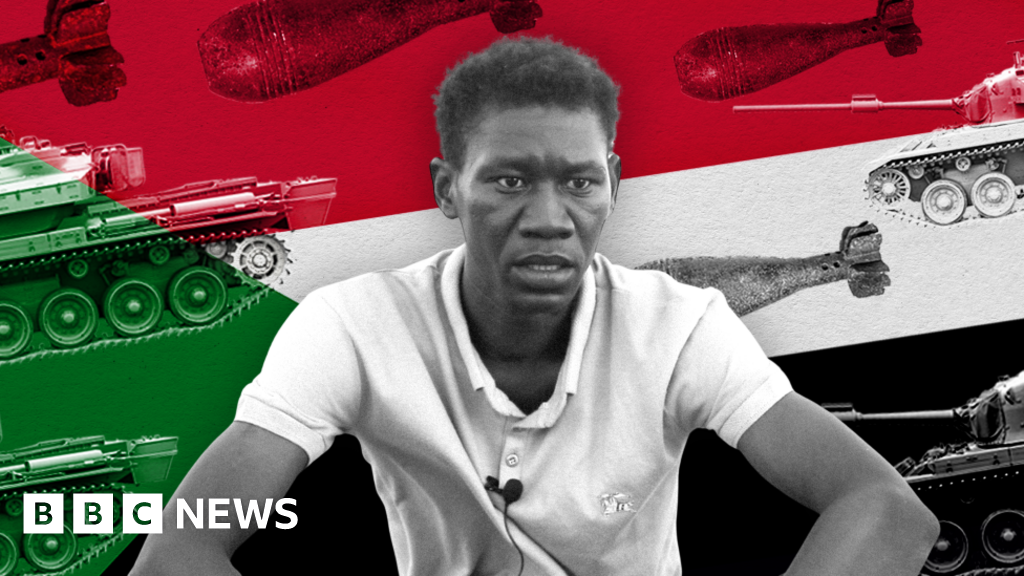
A man who escaped from the last functioning hospital in the Sudanese city of El Fasher before a massacre by paramilitary forces says he has lost all hope and happiness.
Abd Rabbo Ahmed, a laboratory technician at the Saudi Maternity Hospital, told the BBC: “I lost my colleagues.”
“I lost people whose faces I used to see smiling… It’s as if you lost a big part of your body or soul.”
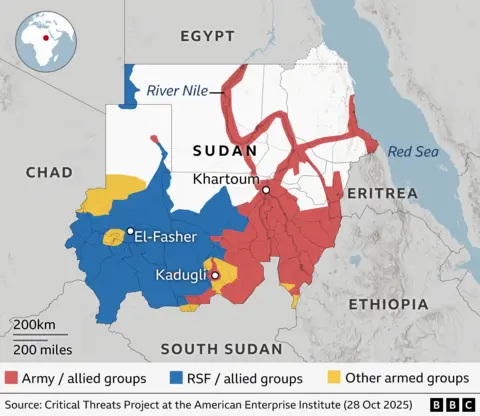
He was speaking to us from a camp for displaced people in Tawila, about 70 kilometers (43 miles) west of El Fasher, the regional center that the paramilitary Rapid Support Forces took control of in the last week of October after an 18-month siege.
The Rapid Support Forces have been fighting the Sudanese army since April 2023, when the power struggle between their leaders turned into a civil war.
At least 460 patients and their companions were killed in the Saudi Hospital It was one of the most shocking among the wide-ranging accounts of atrocities – Some of them were photographed by Rapid Support fighters and published on social media.
In a statement of condemnation, the World Health Organization said it was “deeply appalled and shocked” by the news of the shooting and kidnapping of six health workers – four doctors, a nurse and a pharmacist.
The Rapid Support Forces rejected these accusations, describing them as misleading information, declaring that all El Fasher hospitals had become deserted. These allegations were refuted by filming a video clip inside the hospital grounds showing female volunteers caring for patients.
A freelance journalist based in Al Taweelah collected interviews for the BBC.
Mr Ahmed told him that he had continued to work at the Saudi hospital since the beginning of the war, despite regular bombardment by artillery, tanks and drones – destroying parts of buildings and injuring doctors and nurses as well as patients.
He added that the medical staff had become accustomed to sharing the little food available as the siege of the Rapid Support Forces tightened, and sometimes worked without breakfast or lunch.
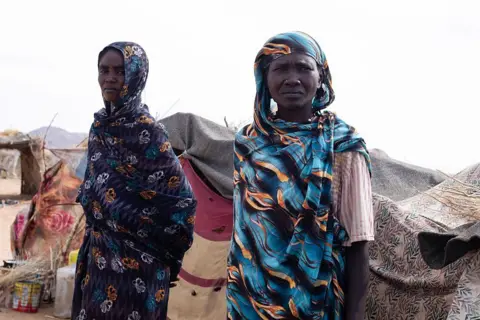
Most of them fled when the paramilitary fighters launched their final attack.

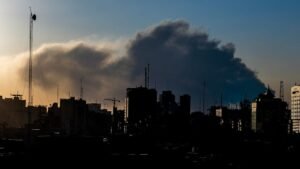
 AFP via Getty Images
Ahmed said: “The bombing started around six in the morning.”
“All the civilians and soldiers headed towards the south side. There was terror, and as we were walking, drones were bombing us. And heavy artillery too – I saw a lot of people dying on the spot, and there was no one who could save them.”
Mr. Ahmed said that some of the fleeing medical workers arrived with him in Al-Tawila, but many of them were arrested in locations northwest of the city, such as the Al-Qarni area, the villages of Tora and Hillat Al-Sheikh, and the town of Korma.
He added that some of them were transferred to Nyala, the de facto capital of the Rapid Support Forces in South Darfur.
“This is the information I received from my colleagues who we know,” he told the BBC, adding that he later heard the execution of the medical staff who remained in the hospital.
Mr. Ahmed also lost many members of his family: his sister and two brothers were killed that day, and his parents are also missing.
He added, “I am very concerned about the fate of the people inside El Fasher.”
“They may be killed. They may be used as human shields against… [Sudanese air force] Air strikes.”
Two groups of Sudanese doctors reported accounts of the alleged hospital massacre, citing sources on the ground and a network of activists in El Fasher.
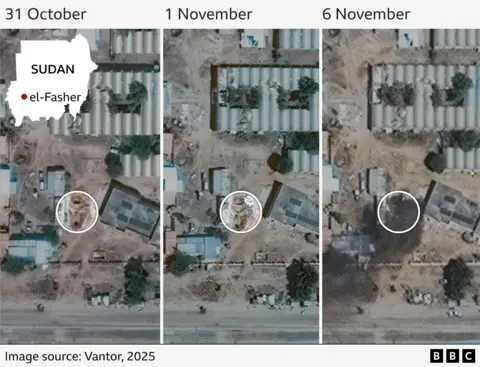
Yale University’s Human Research Laboratory said satellite images confirmed the reports, showing what appeared to be blood on the ground and white clumps resembling bodies in the hospital complex.
In the satellite image taken on November 1, the white objects appear placed in an excavated area inside the hospital complex. In a later photo taken on November 6, these objects were seen charred and smoke was still rising from the area.
The BBC verified the authenticity of footage filmed at the Faculty of Medical Laboratory Sciences at nearby El Fasher University: it shows bodies lying on the ground and a Rapid Support Forces fighter shooting one of the men who is still alive.
Sudan Doctors Network spokesman, Dr. Muhammad Al-Sheikh, told the BBC that this building is used as an extension of the Saudi Hospital for wards and patients.
He explained that the Rapid Support Forces were demanding a ransom in exchange for the release of the kidnapped health workers.
He added, “The six kidnapped doctors or medical staff, one of them and his family, were able to pay a ransom equivalent to 30,000 dollars.” [£23,000]“He arrived safely in the city of Taweelah,” said Dr. Al-Sheikh, who now works for the National Health Service in the United Kingdom.
He added, “The other one was executed,” explaining that the organization had no information about the fate of the remaining four.
Back in Tawila, Mohammed Abdo Tia, who was a patient in the Saudi hospital when the Rapid Support Forces approached, could do little but lie on the ground with his leg in a torn cast.
He told the BBC that he was broken during an artillery shelling, but he was able to flee the city on foot on the morning of the last RSF attack.
Abdou Tia says, like many other men suspected of being soldiers, he was stopped at the Garni checkpoint and interrogated. The two men who were with him were taken, but the RSF let him go.
“They didn’t beat me, but they questioned me a lot, I think because of my injury. They said: ‘We know you’re a soldier, but you’re done – you’ll die on the road. So just go.’”
Mr. Abdo Tia says the Rapid Support Forces brought some medicine to Al-Qarni, but “the casualties were too many – two or three people die every hour.”
“On the same day we arrived, cars came and took people to unknown places. Any young man who looked physically well was taken away.”
He was able to obtain transportation to Tawila from “people with cars.” He said they charged passengers 500,000 Sudanese pounds ($830, £630) and turned on Wi-Fi hotspots so they could contact their families to transfer money. “We left with them, and we didn’t have anything, not even plans.”
Many children arrived at the Tawila camps without their parents. Fifteen-year-old Iman was one of them.
She told the BBC that her father was killed in a drone strike in El Fasher, and her mother and brother were arrested by the Rapid Support Forces as they fled.
“Who is not dead [the RSF] She said: “I ran them over with vehicles. They took our luggage and told us that you are all soldiers. They beat my brother and strangled him with a chain.”
“They wanted to beat my mother. She told us: ‘Go, I will come to you.’” We got into the car and left. They did not allow my brother to ride in the car. “We left them behind.”
Iman escaped, but she saw other girls and women who were unable to do so.
“They took some women. They took them in their cars and stabbed some of them with knives. Others were taken while their mothers could not do anything.”
Survivors told horrific stories of gang rapes and kidnappings of young girls.
Another teenager, Samar, 14 years old, said that she lost her mother in the chaos that took place at the Al-Qarni checkpoint, and her father was arrested.
She was told that he had been transferred to the children’s hospital in El Fasher.
This building reportedly served as a detention center for the Rapid Support Forces, a place where Yale researchers also said satellite images showed evidence of the killings: clear clusters of bodies as well as ground excavations that could be a mass grave.
The Rapid Support Forces published video clips to respond to these allegations, announcing that the Children’s Hospital in El Fasher is ready to receive patients.
One shows a man in a jacket standing outside his gate with a group of doctors who appear to be wearing hospital scrubs.
The man wearing the jacket says: “These medical teams and personnel are not hostages.” “We are not taking them hostage of war. They are free. They are free to practice medicine.”
Another man in the video, who identifies himself as Dr. Ishaq Abdel Mahmoud, associate professor of pediatrics and child health at El Fasher University, says: “We are here to help anyone who needs medical service.
“We are outside politics. Whether soldiers or… [civilians] We are ready to help them.”
Dr. Al-Sheikh from the Sudan Doctors Network rejects the videos published by the Rapid Support Forces as propaganda.
Mr. Ahmed, the laboratory technician at the Saudi Hospital in Taweelah, knows what he saw, and he has seen a lot.
“I have no hope of returning to El Fasher,” he says.
“After everything that happened and everything I saw. Even if there is a small hope, I remember what happened in front of me.”
Additional reporting from BBC Investigator Peter Mwai
More BBC stories on the Sudan crisis:
 Getty Images/BBC
https://ichef.bbci.co.uk/news/1024/branded_news/d4a4/live/803edc20-bf1f-11f0-8669-5560f5c90fbe.png






إرسال التعليق