











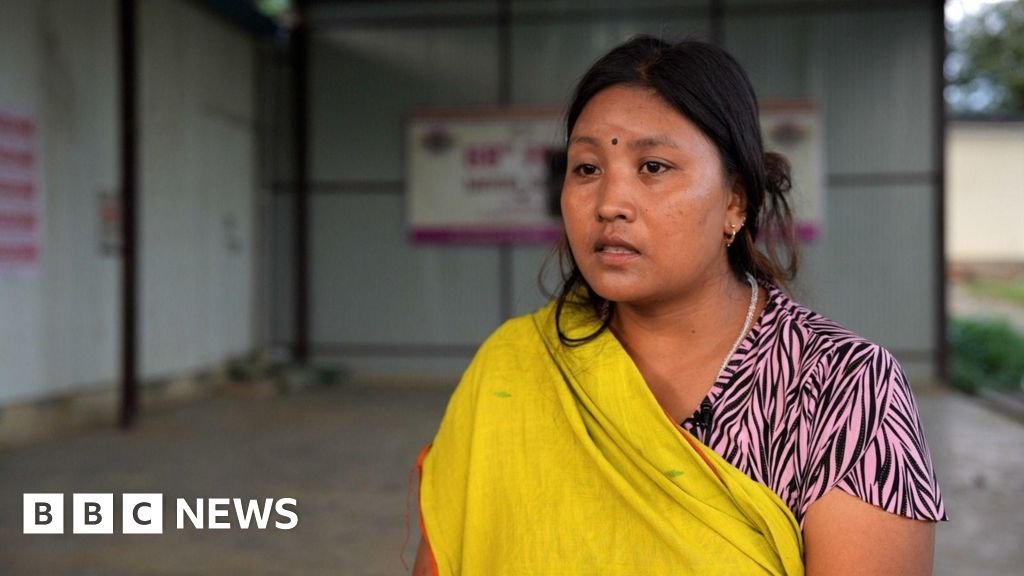
Displaced families fear the looming resettlement deadline
2025-10-31 00:29:58

 Medhat Allah Al-Hassani
Thousands of people displaced by ethnic clashes that broke out in the northeastern Indian state of Manipur two years ago now face an uncertain future, with the government planning to close all temporary relief camps by December.
The violence, which broke out in May 2023 between the majority Métis and Kuki indigenous communities, was the worst the region had seen in decades.
It began after protests by the largely Christian Kuki community against the Métis, mostly Hindus, who were demanding official tribal status that would give them access to the same government benefits and job quotas as other tribes, including the Kuki.
At least 260 people were killed in the clashes, and about 60,000 displaced people have since been living in temporary shelters.
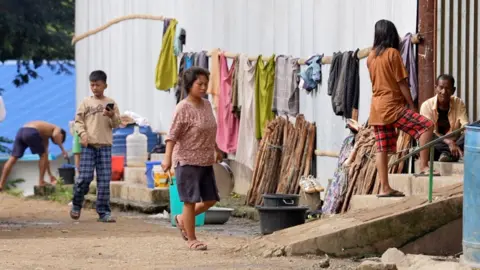
Over the past two years, the government has made repeated promises to rehabilitate the displaced, but not much has changed on the ground. Many say their lives remain in limbo – they are homeless and without a stable source of income.
Concerns grew in July when the then state chief secretary, Prashant Singh, announced that all relief camps would be closed by December and their residents would be resettled.
He added that those who cannot return to their homes will be moved to prefabricated housing units.
However, the government has not made it clear where these units will be – whether near relief camps or near the original homes of displaced people – raising concerns about the future.
Uncertainty increased in September when Prime Minister Narendra Modi, during his first visit to Manipur since the violence began, announced that 7,000 new homes would be built to resettle displaced people in “suitable sites” without providing any further details.
 Medhat Allah Al-Hassani
On land, Manipur remains sharply divided: the Metis inhabit the Imphal valley, while the Kukis live in the surrounding hill regions; Security forces continue to patrol the buffer zones separating the two communities.
A security official deployed in the region told BBC Hindi that his mission is to “ensure that Metis and Kukis remain in their areas and do not mix.”
Experts say resettling people to their original neighborhoods is crucial to prevent violence from redrawing the social map of Manipur.
“This is not good for secular and democratic India. Their resettlement to their original homes is the most important thing,” said RK Nimai Singh, former secretary to the governor of Manipur.
He added that many displaced people fear that if they leave relief camps and move to temporary housing, they may never be able to return to their homes.
It’s a thought that haunts Hatno Hokeb. For her, home means only one place – Imphal Valley – and she longs to return.
“But this cannot happen because our village is now surrounded by Meitei people,” said the 22-year-old, who now lives in a relief camp in the mountainous Churachandpur district.
Ms Haukip added that she would feel safer if Kuki leaders were given the autonomy to create an organisation Separate territory under federal administration of the community.
This sentiment has been echoed by several other members of Kuki’s family, who are also anxious about returning to their homes.
On the other hand, most of those spoken to by BBC Hindi said they wanted to return home.
Irum Apong, who previously ran a water supply company in Churachandpur, now lives in a relief camp near a buffer zone.
His home was damaged during the violence, but Mr Apong says he will never give up the place he once called home.
“My land remains. I will never sell it because I know I will return one day,” he said. “Efforts must be made to bridge the gap between our two communities so that people can return to their lives.”
The concern, coupled with uncertainty about where new homes will be built, has raised doubts about whether the government will be able to close all relief camps by December.
However, government officials insist that the resettlement plan is on the right track.
“From about 290 camps initially, we have brought the number down to about 260,” a senior Manipur government official said.
“Ultimately, we want to resettle people in the areas they fled, once they feel safe to return,” he added.
The official added that although they understand people’s concerns, it is also in the country’s interest for them to return home, otherwise the divisions will deepen.
 Medhat Allah Al-Hassani
As tens of thousands of people continue to live in relief camps, many complain that they are not getting the facilities the government promised them.
Nimhuichung Longdim, a single mother, said her 11-year-old son suffered a serious eye injury a few months ago and lost the sight in one eye.
After government doctors failed to help him, she borrowed money to transfer him to a private hospital, but she was unable to afford the treatment.
“I was told it would cost around 300,000 rupees ($3,400; £2,600). I don’t have that kind of money,” she said.
Ms Longdim says the government sometimes organizes health camps, but she has never treated her son. BBC Hindi has contacted officials for a response.
Inside the camps, residents say prolonged displacement and uncertainty are also affecting people’s mental health.
Salam Monica, 25, says her uncle committed suicide last year after becoming despondent over the lack of opportunities to earn a living. She says the family was unable to get medical help.
“Some mental health workers have visited our camp several times since 2023, but they did not come at all this year,” she said.
BBC Hindi has contacted the government for comment.
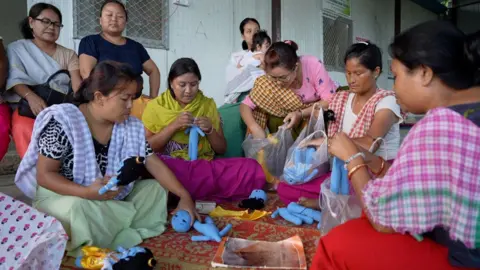
Meanwhile, those who were moved from camps to temporary housing say that although they now have a roof over their heads, they are still struggling to make ends meet as livelihood remains a concern.
Chingakham Radha, one of the newly resettled residents, said she learned to make crochet dolls while living in the camp and now earns a small income from selling them. “There is very little money, but it is enough to make ends meet,” she said.
Before the conflict, Ms Radha was a housewife and her husband worked as a labourer. They were not rich, but they lived a happy life.
Thinking of those days, Ms. Radha says life is more uncertain now.
“Some days my husband finds work, but other times weeks go by without any work,” she said. “I want to return home to Churachandpur, but these hopes are dwindling with time.”
Follow BBC News India on Instagram, youtube, X and Facebook.
https://ichef.bbci.co.uk/news/1024/branded_news/6791/live/15fe0730-b4c2-11f0-9ba4-690ca23769a4.jpg













إرسال التعليق