











China’s investment crash raises credit risks for homebuilders, banks, government: Fitch
2026-01-21 08:44:07
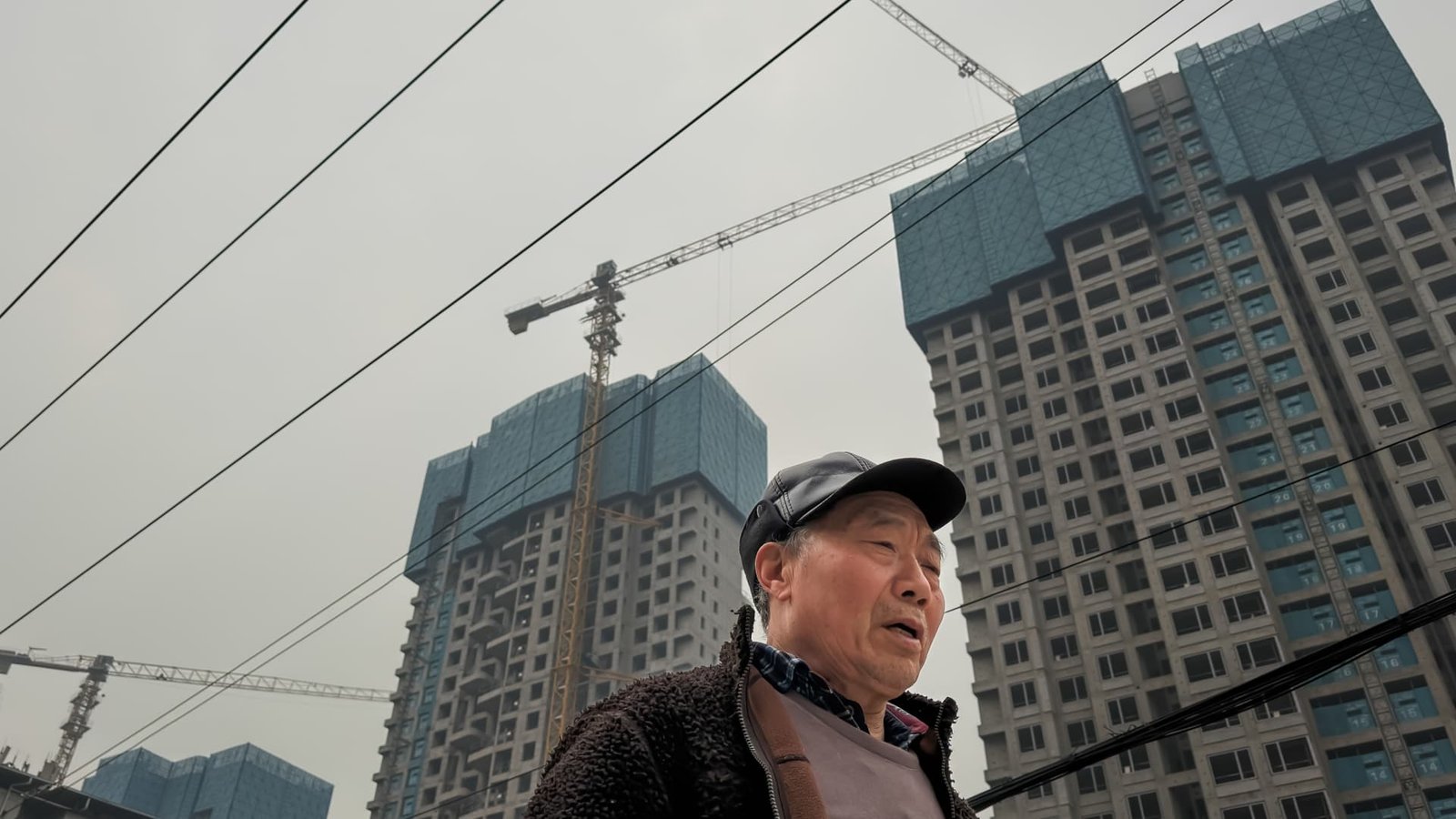
CHONGQING, CHINA – JANUARY 16: An elderly man walks along a street with high-rise residential buildings under construction in the background, as tower cranes and overhead power lines are visible on January 16, 2026, in Chongqing, China.
Cheng Shen | Getty Images News | Getty Images
Fitch Ratings warned that the sharp decline in investment in China is amplifying credit risks throughout the economy, especially the homebuilders, real estate companies, banks and construction sectors, as the slowdown in the economy hampers their growth and ability to repay debts.
China’s fixed asset investment, or FAI, fell 3.8% in 2025 to 48.52 trillion yuan ($6.8 trillion) — the first annual decline in decades — as a deepening slump in real estate and tighter limits on local government borrowing crimped one of China’s traditional growth engines.
The sharp decline in investment in the second half of 2025 has raised significant credit risks across sectors for China’s rated issuers, including the government, Fitch said. Rating agency Downgrading China’s sovereign rating to “A” from “A+” in April due to concerns about weak finances and high public debt.
Fitch warned that the growth outlook for many sectors is “deteriorating,” citing weak domestic demand, deep deflationary pressures and a decline in real estate.
The world’s second-largest economy lost momentum in the last quarter of 2025, recording growth Slowest growth in three years at 4.5%.
Among the FAI, real estate investment fell for the fourth year in a row, It fell 17.2% last year Compared to last year, the decline in the housing sector continued to drain activity across builders and upstream suppliers. Nationwide residential sales fell to 7.3 trillion yuan (1 trillion US dollars). Lowest level since 2015While the prices of existing apartments continued to decline.
The painful downturn in the housing market has prompted millions of households to cut back on spending, forcing companies to lower prices and squeezing profit margins in the process.
The real estate downturn has pushed many cash-strapped developers into distress. Last month, Fitch downgraded China Vanke, once the country’s largest developer, to “limited default” as the company sought an extension of the local bond payment deadline.
Earlier this month, Fitch downgraded the ratings of Dalian Wanda Commercial Management Group and Wanda Commercial Real Estate Company to “limited default” upon completion of the distressed debt swap. Jingrui Holdings was ordered last week to wind down its operations in Hong Kong.

The rating agency expects China’s GDP to grow by 4.1% due to easing net trade and slowing consumer spending. The continued double-digit decline in fixed asset investment will likely not be able to sustain 4% to 5% growth in 2026, Fitch said.
However, Goldman Sachs noted that concerns about the sharp decline in investment may be overblown, as the decline may be partly due to “a statistical correction of previously over-reported data, rather than a true slowdown.”
Financial pressures faced by local governments
Samuel Kwok, managing director of international public finance for the Asia-Pacific region at Fitch Ratings, said local government financing instruments are still far from self-sufficient in debt servicing. The debt is classified as “neutral” based on expectations that the authorities will intervene if pressures intensify.
Kwok said a “stronger than expected” fiscal stimulus plan financed by local public sector debt could deteriorate the sector’s outlook for local loan financing instruments and issuers, if the debt used for “quasi-political” investment rises faster than local loan financing instruments and the ability of local governments to support it. Parapolitical investment refers to projects financed extra-budgetary through local government financing programs rather than direct fiscal spending to advance government policy objectives.
Local governments have suffered a loss in revenue from land sales, while Beijing has tightened its grip on local authorities’ financing instruments, limiting their investments in infrastructure.
FDI excluding real estate fell 0.5% for 2025, as state budget capital spending shrinks due to local governments’ focus on debt repayment, said Erica Tai, director of macro research at Maybank.
HANGZHOU, CHINA – JANUARY 16: An aerial view of the No. 8 Main Tower of the North Navigation Channel Bridge along the railway bridge across Hangzhou Bay on January 16, 2026 in Hangzhou, Zhejiang Province, China.
Ni Yanqiang/Zhejiang Daily Press Group | China Optical Group | Getty Images
Tai added that Beijing’s push to stimulate infrastructure construction for the digital economy could lead to a slight rebound in public investment in 2026, offsetting some of the weakness in real estate construction.
Fitch noted that while a slowdown in investment from local governments could hamper growth in some “economically weaker areas,” tighter restrictions on new borrowing could gradually improve the credit profiles of some local government financing instruments.
Concerns about the quality of the bank’s assets
China is likely to stick to a cautious approach to its monetary policy, with banks expected to prioritize high-quality borrowers over chasing loan growth – a stance that Fitch said should help keep asset quality broadly stable.
The ratings firm expects the central bank to cut the 7-day reverse repo rate by 20 basis points this year to 1.2%, noting there is limited scope for further aggressive easing given banks’ already stressed profitability.
Fitch expects a “slight deterioration” in banks’ asset quality, if at all. But it warned that a deeper investment slump leading to a meaningful rise in unemployment could weaken lenders’ asset quality and put pressure on residential mortgage-backed securities and other asset-backed securities.
The nationwide unemployment rate rose to 5.2% in 2025, from 5.1% the previous year.
The agency added that a more aggressive push to lift lending growth could have a negative credit impact for banks, as it could compress net interest margins or significantly increase leverage across the system.
China’s top financial regulator extended a policy earlier this month to allow banks to dispose of bad personal loans beyond the original 2025 deadline, according to Bloomberg, easing pressure on banks as the risk of default rises.
https://image.cnbcfm.com/api/v1/image/108254012-1768882555010-gettyimages-2256559858-img_6032.jpeg?v=1768882566&w=1920&h=1080















إرسال التعليق