











Can Trump’s shattered plan be glued back together?
2025-12-13 01:37:12

 AFP via Getty Images
The US ambassador to the United Nations accused Rwanda of leading Africa’s Great Lakes region towards war, just over a week after a peace deal was signed in Washington to end the decades-long conflict.
US President Donald Trump praised the agreement between the President of the Democratic Republic of the Congo, Felix Tshisekedi, and the President of Rwanda, Paul Kagame, calling it “historic” and “a great day for Africa, and a great day for the world.”
But the M23 rebel group says it has “completely liberated” the main city of Uvira in an offensive launched by the United States and European powers. He says Rwanda supports it. UN experts have previously accused it of effectively controlling the operations of rebel forces.
Rwanda denies these accusations, but its presence in Washington was an implicit acknowledgment of its influence over the M23 movement.
The rebels were not signatories to the Trump agreement, and were participating in a parallel peace process led by Qatar, an ally of the United States.
The latest fighting threatens to escalate an already complex conflict.
Why has the M23 movement captured Uvira now?
Professor Jason Stearns, a Canada-based political scientist who specializes in the region, told the BBC that the prevailing view in M23 circles is that “they need more leverage in the negotiations”, while the prevailing feeling in the Rwandan government is that Tshisekedi cannot be trusted.
He added that the attack on the city of Uvira in South Kivu province “contradicts all ongoing negotiations.”
Professor Stearns told the BBC: “This appears to be a humiliation for the US government. I am not sure what strategic purpose this will serve.”
The M23’s new offensive in South Kivu began a few days before Kagame and Tshisekedi traveled to Washington last week to ratify the agreement that was first reached in June.
Bram Verelst, Burundi-based researcher at the Institute for Security Studies (ISS), said the attack appeared to be an attempt to force Burundi to withdraw its forces present in eastern DRC to support the army against rebel forces and Rwanda.
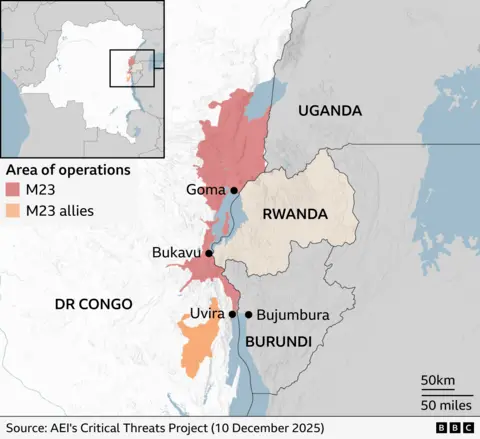
He noted that Uvira – located just 27 kilometers from the Burundian capital Bujumbura, on the northern tip of Lake Tanganyika – was of strategic importance due to the presence of at least 10,000 Burundian soldiers in South Kivu.
“Uvira is Burundi’s gateway to eastern DRC for sending troops and supplies. That has now been cut off,” Verelest told the BBC.
“It appears that many Burundian forces are withdrawing, but it is not clear whether all units will withdraw,” he added.
Yale Ford, Africa analyst for the Critical Threats Project at the American Enterprise Institute, noted that Uvira, with a population of about 700,000, was the DRC’s last major foothold and its military outpost in South Kivu.
He added that The M23 movement is now likely to establish a parallel administration in the cityand using its military gains “as a bargaining chip in peace talks.”
As for the government of the Democratic Republic of the Congo, it did not acknowledge the recent military setback, but said that “the seriousness of the situation is exacerbated by the now certain danger of a regional conflagration.”
What does it mean for Burundi?
Burundi has been a natural ally of the Democratic Republic of the Congo for years due to its hostility with Rwanda.
Each accuses the other of supporting rebel groups seeking to overthrow their governments.
The neighbors share a similar language and ethnic makeup – Tutsi and Hutu communities often compete for power – and both have suffered terrible ethnic massacres.
But unlike Rwanda, which has a Tutsi president, a Hutu majority holds power in Burundi.
The Burundian government fears that if the M23 strengthens its presence in South Kivu, it will strengthen the power of a Burundian rebel group called Red Tabara.
It is based in South Kivu, and is mainly made up of Tutsis – and has attacked Burundi in the past.
In an apparent attempt to allay Burundi’s concerns, the M23 movement said it “does not have any vision beyond our national borders.”
“The goal of our battle is to achieve peace, protect the population and rebuild the state in the Democratic Republic of the Congo, as well as stabilize the Great Lakes region,” the group added.
Burundi has closed its border with the Democratic Republic of the Congo, but according to Mr. Verelest, it is still allowing people to cross into its territory after conducting security checks.
Aid agencies say about 50,000 people have fled to Burundi in the past week.
Burundian forces, along with the Congolese army and allied militias, fought to prevent the rebel advance towards Uvira, but the city itself fell “without much of a fight,” Verelest said.
He added that the fall of Uvira would harm Burundi’s already faltering economy, as the country suffers from severe shortages of foreign currency and fuel, and was heavily dependent on eastern DRC for both.
How did M23 manage to capture Uvira?
The M23 movement began a major advance earlier this year when it captured Goma, the capital of North Kivu province, on the border with Rwanda.
At the time, South African troops were deployed to assist the DRC army, but were forced to withdraw after the M23 movement seized the city in January.
Shortly afterwards the rebels captured the next large city in eastern DRC, Bukavu, the capital of South Kivu.
The move on Uvira came after the rebels were able to break the defensive lines of the Democratic Republic of the Congo army, its allied militias, and Burundian forces.
Professor Stearns said the M23 was estimated to have more than 10,000 fighters, but there was likely an “influx” of Rwandan troops to take part in the final offensive to seize Uvira.
“The reason they were able to defeat their enemy is because the Rwandan army, at least, is very disciplined, and I think discipline is more important than manpower,” he said.
“The conflict in recent days has also seen extensive use of drone technology on both sides, but the Rwandans have used this to their advantage more than the Congolese,” he added.
Where does this leave the peace process?
She seems to be in deep trouble.
The US ambassador to the United Nations blamed Rwanda for the recent fighting.
“Instead of progressing toward peace, as we have seen under President Trump’s leadership in recent weeks, Rwanda is leading the region toward greater instability and toward war,” Mike Waltz said at a Security Council meeting.
An earlier statement from the United States, the European Union and eight European governments went further, saying that the M23 and the Rwandan Defense Forces must immediately cease “offensive operations,” and Rwandan forces must withdraw from eastern DRC.
Professor Stearns said the policy experts he spoke to were “puzzled” by the timing of the move to take control of Uvira.
“When they were signing the peace agreement in Washington, the Rwandan forces were mobilizing forces and then invaded the area around Kamanyula, which is across the border with Rwanda, and then advanced towards Uvira,” he added.
The Rwandan Foreign Ministry did not respond to allegations that its forces were in South Kivu, but said that ceasefire violations and fighting could not be “attributed” to Rwanda.
It accused the armies of the Democratic Republic of the Congo and Burundi of bombing villages near the Rwandan border, and said that Burundi had “mobilized” nearly 20,000 soldiers in South Kivu to support the army of the Democratic Republic of the Congo.
She added that it was now clear that the DRC “was never ready to commit to peace,” and although Tshisekedi attended the ceremony in Washington, it was “as if he was forced to sign” the peace agreement.
The Democratic Republic of Congo’s government made a similar accusation against Kagame, saying he made a “deliberate choice” to abandon the Washington agreement and undermine Trump’s efforts to end the conflict.
Can the deal be saved?
Professor Stearns said the US-led peace process was now on a “troubled path and may be stuck”.
He noted that the success of the deal hinges on the DRC army carrying out an operation to disarm the FDLR militia, whose members participated in the 1994 Rwandan genocide and which Kagame’s government views as a continuing threat.
But Professor Stearns said he could not see the DRC army launching such an operation at the moment.
The peace agreement also provided for economic cooperation between the DRC and Rwanda, including hydropower, mining and infrastructure development — something the United States hopes will pave the way for American companies to increase their investments in the mineral-rich region.
Professor Stearns said he could not expect this to happen while Rwandan forces remained in eastern DRC and fighting continued.
He added that his understanding is that the parallel peace process in Doha – led by the government of Qatar to broker a peace agreement between the M23 movement and the DRC government – is also on hold at the moment.
He added, “It is very difficult to imagine the Congolese returning there now that the M23 movement launched this major attack.”
What are Tshisekedi’s options?
Professor Stearns said Tshisekedi had come under “very serious” pressure from the public over his failure to deliver on his numerous promises to end the fighting in the east.
He added that Tshisekedi may also be under pressure from parts of the army, with which his relationship has been strained after the arrest of generals over corruption allegations and due to setbacks in the east.
He added that Tshisekedi was counting on the United States to pressure Rwanda to withdraw its support for the M23 movement.
“It will be very difficult for the Congolese army to muster a response,” he added.
“The matter is now in the hands of various peace mediators, the United States in particular, and perhaps Qatar and other donors,” the academic said.
“We have to see how interested they are in ending this conflict, and how much political capital they are willing to spend.”
More on the conflict in the Democratic Republic of the Congo:
 Getty Images/BBC
https://ichef.bbci.co.uk/news/1024/branded_news/21e6/live/1a470ad0-d759-11f0-845f-035d2c9c25f7.jpg










إرسال التعليق