










Biologist bitten in head by shark hopes to meet animal again
2025-11-11 15:56:32
Raphael AbushibeBBC News Mundo

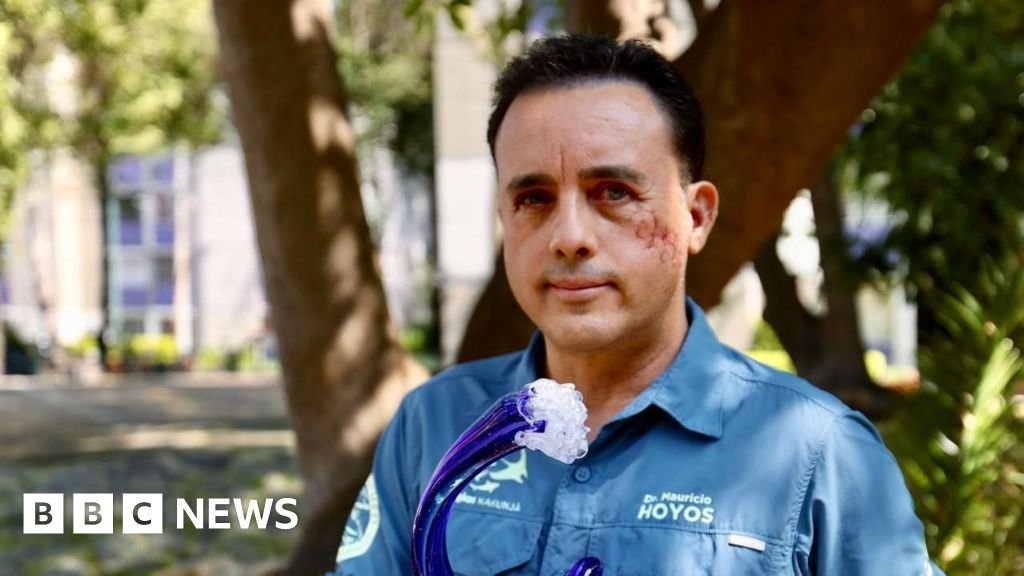
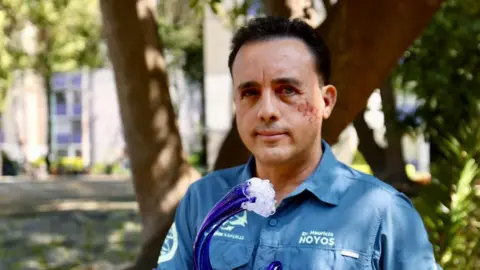 Mauricio Hoyos
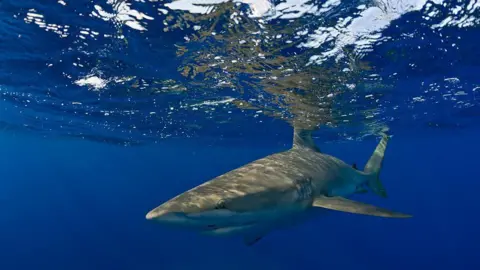
Mauricio Hoyos still remembers the pressure the jaws of the female Galapagos shark, more than 3 meters (10 feet) long, exerted on his skull.
The animal lunged at him with astonishing speed, giving him barely enough time to lower its head in a last-ditch effort to protect his jugular vein.
“When he closed his jaw, I felt the pressure of biting, and after what I think was a second, he opened it again and let me go,” Hoyos told BBC Mundo from his home in Baja California, Mexico, just over a month after he survived the accident.
Hoyos, a marine biologist with more than 30 years of experience studying sharks in their natural habitat, was on a research trip in Costa Rica when he was attacked by the shark in September.
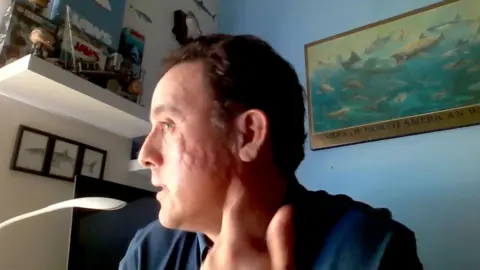
Less than two months later, and still bearing the scars on his face from the attack, he describes his recovery as “amazing” – and says he hopes to face his attacker again.
For Hoyos, what happened to him that day in the waters off Cocos Island is the result of normal animal behavior when faced with a potential threat.
“In this case, it was like a dog bite,” he says.
“Have you ever seen how dogs, when another dog gets too close to them, give a quick bite? It doesn’t hurt them, but it calms the other dog down.”
Hoyos – who with colleagues attach acoustic tags to sharks to help locate mating and breeding sites as part of his work – was alerted to the shark’s presence in the water by tourists.
It was at a depth of 40 metres, and Hoyos told the captain of the boat he was on board that he would remain there “for a maximum of five minutes”.
Then he entered the water and began his slow descent.
 Getty Images
Hoyos recalls his encounter with the shark: “This giant female, 3 to 3.5 meters (11.5 feet) long, swam and headed towards the bottom, and I positioned myself to mark her at the base of her dorsal fin.”
But Hoyos, who has tagged many shark species over his decades-long career, says this animal reacted differently to others.
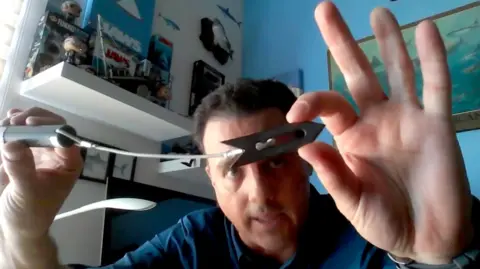
“The tip — the metal end attached to the cable dangling from the probe — obviously goes in, and unlike other sharks I’ve tagged who immediately run away, they turn around and stare at me,” he recalls.
“I saw her little eye looking at me, and I saw her turn very quietly.”
Hoyos says he was looking at the shark swimming away, but then, suddenly, out of nowhere, it lunged at him.
“I lowered my head, and what I felt was his lower jaw digging into my cheek and his upper jaw into my head. I was there, I imagine for a moment, no more, inside his jaw, and then he simply opened it again.”
“When I closed it, I felt the pressure of the sting, and then she let me go,” he marvels.
The Galapagos shark’s 29 serrated teeth not only left Hoyos with deep cuts to his face and head, but also severed the air line to his scuba gear.
He had survived the shark attack but was still in mortal danger.
In addition, one of his teeth had torn off his diving mask, and the blood-stained water was further blurring his already limited vision.
He told BBC Mundo: “When I realized that the air wasn’t coming out of the hose, I grabbed another hose we have, which we call the octopus, which is used to give air to someone else if they need it.”
“But then I realized the regulator wasn’t working and was blowing air instead of regulating it, so I had to remember my drill and start regulating it with my lips.”
He was bleeding, blinded, and with air escaping, Hoyos calculated he had less than a minute to reach the surface.
“Since I couldn’t see anything, what I did was look for the light that I knew was on the surface. I started swimming up, in a very coordinated way, because I wanted to avoid erratic movements that might attract the shark.”
 Mauricio Hoyos
After Hoyos reached the surface, a young man pulled him onto the boat, and when the captain saw his condition, he called the park ranger station to report the incident.
Hoyos explained that he did not feel the pain of his injuries until much later.
“Obviously I had adrenaline flowing in my body, but the sting didn’t hurt that much. What hurt the most was the impact: when I was bitten by a shark – an animal 3 meters long and that fast – it was like being hit by a car. In fact, I ended up with a big bruise all over my jaw; I thought it was broken.”
When the ship docked, a team of paramedics was ready to provide emergency care to him.
Hoyos was lucky: in addition to surviving the attack and subsequent ascension, none of his wounds became infected, and the healing process took less time than anyone had imagined.
“The doctors told me it was amazing: the attack happened on the 27th [September]I had a 34-hour flight, and they performed debridement [removing damaged tissue]Two days later they were already evaluating whether they could do reconstructive surgery.”
It could have been much worse for Hoyos. According to doctors, a young man who survived a Galapagos shark attack in the same area in 2017 had to stay in a hyperbaric chamber for about a month because his wounds did not heal properly.
“They told me my recovery was amazing. After the surgery, the doctors admitted how worried they were about the infection, because having it on my face was a direct route to the brain.”
 Mauricio Hoyos
Smiling broadly, Hoyos adds that he is already planning to get back in the water and has booked a diving trip for November 14.
He says that after surviving an attack of this magnitude, he has more respect for the animals he studies.
“Many people think the oceans would be better off without sharks, but they really say that because they don’t understand the critical role sharks play in maintaining their delicate balance.”
Pointing to the large scar on his cheek, he says: “This is proof that this female saved my life; I can’t put it any other way. This will allow me to continue speaking well about sharks and advocating for their conservation in the future.”
Meanwhile, the Galapagos shark that carried Hoyos in its jaws continues its normal life in the depths, and hopes to be seen again. Since he was able to mark her before she attacked him, this possibility existed.
“In January I will go to Cocos Island, we have a flight from the 20th to the 27th. Obviously I will go to Rocca Sucia [where the attack happened]“I’ll dive in there,” he says undeterred.
https://ichef.bbci.co.uk/news/1024/branded_news/e817/live/298cd6d0-befb-11f0-a970-eb79eb0c7376.jpg














إرسال التعليق