










What we know about Spain’s worst train disaster in over a decade
2026-01-21 19:06:25
Mallory Munsch, Sofia Ferreira Santos, and Alicia Curry

 Reuters
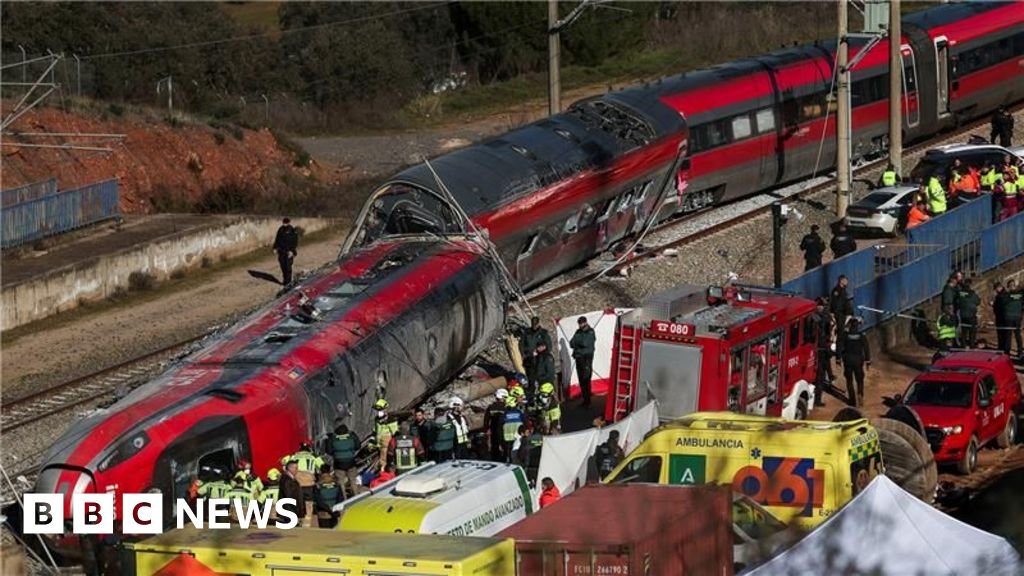
At least 43 people were killed and dozens injured after two high-speed trains collided in southern Spain, local authorities said.
The accident, which occurred in Adamuz, near the city of Cordoba, is the worst railway disaster in Spain in more than a decade.
Here’s what we know about the incident so far.
Where did the collapse happen?
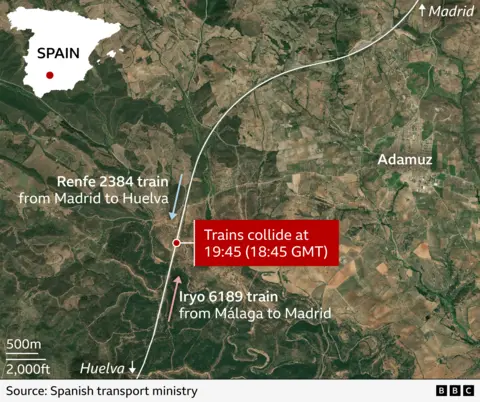
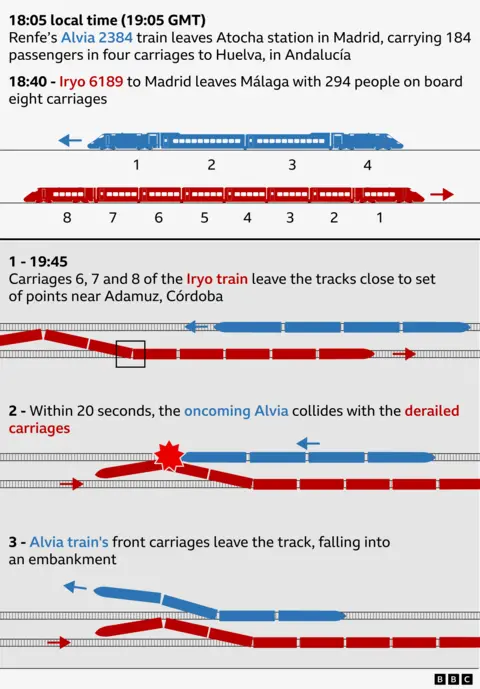
The accident occurred at around 19:45 local time (18:45 GMT) on Sunday, about an hour after a train operated by the private company Aerio left Malaga for Madrid.
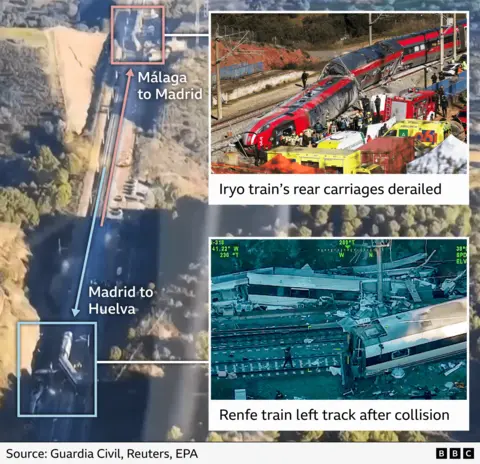
The last three cars of the Erio train – cars six to eight – derailed and crossed into the opposite track.
Spanish Transport Minister Oscar Puente said that those vehicles collided with an oncoming train operated by the state-run Renfe company and was traveling from southern Madrid to Huelva, forcing it to remain on a bridge running alongside the track.
The majority of the dead and wounded were in the front cars of the Renfe train heading to Huelva.
There were about 400 passengers and employees on the two trains, according to Renfei.
What did the survivors say?
Lucas Mirayo, who was in the fifth car of the Madrid-bound Erio train, told the BBC that about an hour into the journey, the ride became very bumpy. He added that the passengers were frightened and the carriage became silent, “then we heard a crash” and the train stopped.
The luggage fell and the lights went out. He added that they then began to hear sounds of pain and screams from the three vehicles behind them that had derailed.
He and his girlfriend were not injured, but people were in shock and crying, and some were suffering from panic attacks. A nurse next to him responded to a call for medical volunteers, and when she returned from the sixth car, she told him that someone had died.
The surviving passengers of the derailed carriages smashed the windows and walked on the tracks to escape. Passengers helped each other disembark, and he saw people seriously injured, with bleeding heads and improvised bandages.
Lucas Mirayo said the first to arrive at the scene were people from Adamuz, some wearing pajamas, and offered to transport the injured.
Two hours later, they were evacuated by bus, and Lucas finally returned home to Madrid on Monday morning, when he hugged his eight-year-old son and began to cry.
“It’s really shocking to be alive when others aren’t,” the Argentine actor and influencer said.
He said the experience of the accident “will be with me all the time.”
Because it was dark, he didn’t realize that the oncoming train had fallen down a bridge until he saw it on the news.
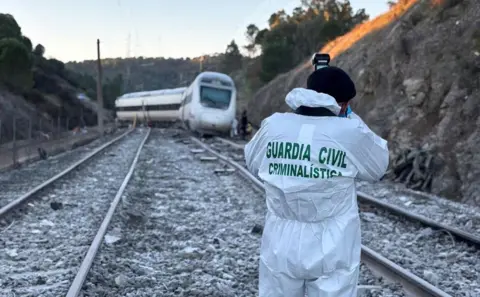 Spanish Civil Guard/Handout via Reuters
The head of the Andalusian regional government, Juanma Moreno, told local broadcaster Canal Sur that they had to bring in “heavy machinery” to “practically lift” parts of the second train, which “took the worst part of this accident.”
“The problem is that the carts are twisted, so the metal is twisted along with the people inside,” Francisco Carmona, Cordoba’s chief firefighter, told Spanish public radio RTVE.
He added: “We even had to remove a dead person so that we could reach a living person. It is hard and difficult work.”
Rescuers continued to search the wreckage until Wednesday, when the forty-third victim was found.
What caused the accident?
The reason for the train derailment is still unclear. Transport Minister Oscar Puente called the accident “very strange” and said that all railway experts consulted by the government were “very puzzled by the accident.”
An investigation has been opened but it is not expected to determine what happened for at least a month.
Interior Minister Fernando Grande-Marlaska was quick to rule out sabotage, but said all other hypotheses were being studied.
The head of Renfei Corporation “denied” the possibility that the accident was due to excessive speed or human error. Alvaro Fernandez Heredia said that even if something went wrong, the system inside the train would fix it and both trains were traveling below the speed limit.
Investigators are focusing on a 30-centimetre gap in the straight section of track that the Erio train passed through, and the Transport Minister said they are assessing whether this broken section was the “cause or consequence” of the accident.
Oscar Puente confirmed reports that coin-sized grooves were found on the wheels of the first five carriages of the Erio train that safely crossed the track before the next three carriages derailed. He added that two or three trains that passed on the track a short time ago had similar cracks.
Experts suggested that a weld failure on the track may have led to it breaking.
Meanwhile, the daily newspaper El País published a transcript of calls made by the Iryo driver and from the Renfe train driver to the control center in Madrid.
The Iryo driver was initially unaware that his train had been involved in a serious accident. The control center is unable to reach the Renfe train driver, so he calls the train conductor who says “I have blood on my head. I don’t know if I will be able to reach the train driver.”
Who are the victims?
The 43 people who died in the accident have not yet been officially identified.
Her friend told the BBC that one of the victims was Maria del Carmen Abril, a teacher, who was returning from a surprise 50th birthday party in Madrid.
Jose Manuel Muñoz described April, as she was known, as a “beautiful, generous and caring person who loved flowers and always tried to solve other people’s problems.”
Victor Luis Teran, a Bolivian national, died on the southbound train to Huelva, after boarding an earlier train due to a last-minute change in plans, his sister-in-law said.
A total of 123 people were injured. As of Wednesday morning, 37 people were still in hospital, including four children. Nine people were in intensive care.
https://ichef.bbci.co.uk/news/1024/branded_news/921a/live/e1d3b5c0-f537-11f0-b385-5f48925de19a.jpg








إرسال التعليق