






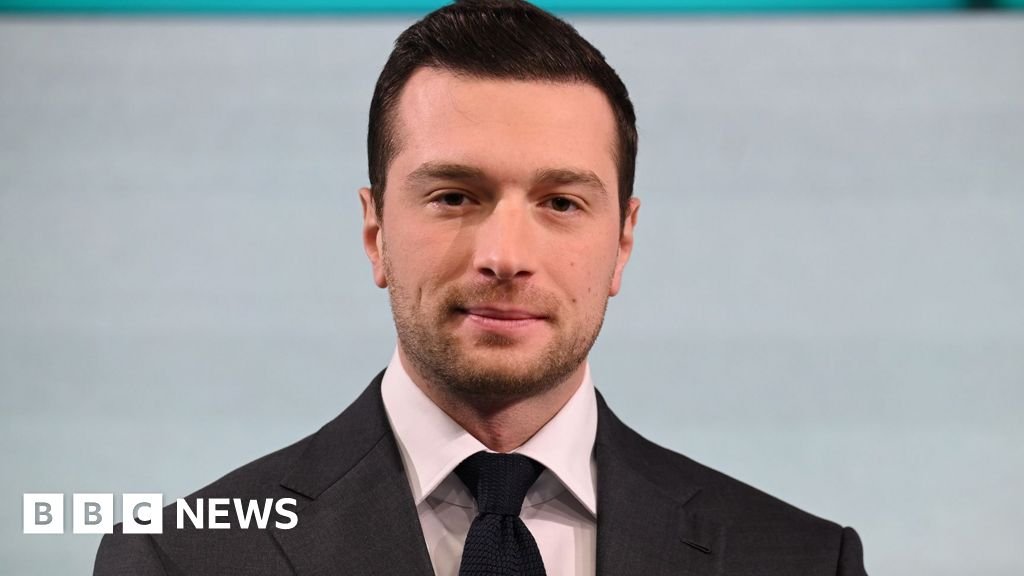
French far-right leader tells BBC he shares US warnings on Europe ‘for most part’
2025-12-10 06:00:08
The leader of France’s far-right National Rally party, Jordan Bardella, “for the most part” welcomed concerns raised about Europe in US President Donald Trump’s new national security strategy.
last week, The White House published a document outlining Trump’s worldview And the state of the European continent, which many described as strongly criticizing Europe.
Speaking to the BBC’s Nick Robinson on his program Thinking Politically, Bardella praised what he described as Trump’s “appeal to American pride” – but made clear he did not want Europe to be “subservient to any major power”.
He said there were “winds of freedom and national pride blowing through all Western democracies.”
In a wide-ranging interview, the 30-year-old, who polls suggest is ahead in the race to become France’s next president, was also challenged on the National Front’s political history and his stance on immigration.
Bardella said he shared most of the concerns expressed by the Trump administration that Europe is facing “civilizational erasure,” which the White House said is fueled by a range of policies, including on immigration.
“Mass immigration and the laxity of our governments in the past 30 years regarding immigration policy are shaking the balance of European countries and Western societies, specifically French society,” Bardella said.
Early parliamentary elections in June 2024 made the National Rally the largest single force in parliament, although a coalition of left-wing parties achieved victory.
The next French presidential election is scheduled for 2027. A recent Le Figaro poll suggests that Bardella will win 44% of the vote – just ahead of Marine Le Pen, the leader of the National Front party whose candidacy is in doubt after she was convicted of embezzling European Union funds and banned from running in elections for five years.
An appeal scheduled for early next year will determine whether Le Pen is able to run, otherwise Bardella is expected to intervene.
Bardella rejected suggestions that raised tensions between them, saying they were united by “trust and friendship.”
He said in his interview: “I will fight alongside her until she can win the appeal. Until the appeal, we will campaign together, as we will next, hand in hand.”
The National Front was founded by Le Pen’s father, Jean-Marie, in 1972. The party, then known as the National Front, has since become a decisive force in French politics. Jean-Marie Le Pen was convicted multiple times for Holocaust denial and was an unrepentant race extremist.
In his interview with Nick Robinson, Bardella distanced himself from Jean-Marie Le Pen’s comments, as have many other FN politicians in recent years.
“I am fighting the caricature of my political movement and my ideas,” he said, adding that it was his responsibility to bring the French people together and present a “project for national recovery” to the country.
“The expectations of my people to break with the past are many,” Bardella added.
Confronting the racist and anti-Semitic history of the National Front’s precursors, Bardella rejected accusations that the National Front had put forward arguments that could “insult” some sectors of the population
He said: “Many Jews vote for us and consider us a bulwark against extremism.”
Primarily known as an anti-immigration party, the National Front has long pushed France to set stricter immigration rules, including limiting social spending to French citizens.
“If I become prime minister tomorrow, France will no longer be a target for mass migration,” he said, adding that if he were elected, his first item would be to hold a referendum on immigration. “It will allow us to regain control of our borders.”
However, according to the French Constitution, a referendum can only be held on certain topics that do not include immigration, so the Constitution must be amended first. In order to do this, the National Rally would have to seize the presidency and have either an absolute majority in parliament or a sufficient number of allies.
Bardella — who grew up in the Paris region but has parents with immigrant backgrounds — made a sharp distinction between people who he said were born in France but “reject republican institutions like the police or values like secularism,” and others who “do everything to become French — embracing the national language, culture, and heritage.”
When asked what it means to be French if being born in the country is not enough, Bardella said he feels being French is an “honor” that transcends bureaucracy.
He said: “Being French means adhering to certain values and ways of life, and believing in equality between men and women.”
Bardella added, “I defend secularism and I feel that political Islam has today become a separate political project… that wants to impose its rules on French society,” before promising to close extremist mosques and prevent “preachers of hatred” from entering the country if elected.
Although he did not elaborate on France’s recurring and long-term financial problems — the country’s debt stands at more than 3 trillion euros, or about 114% of GDP — Bardella said the French economy was “sick.”
“We are facing two diseases: excessive taxation and excessive regulation,” he said, promising to free the country from the “shackles” that limit growth. The National Front has repeatedly voted against annual budgets presented by governments since last year, and has promised to similarly vote against budgets this year.
Bardella’s position on Ukraine also has some differences with the position of the current centrist government. While he stated that Russia represents a “multidimensional threat to French and European interests” and that Kiev would need security guarantees even in the event of a peace deal, he also said he was “strongly opposed” to sending soldiers to Ukraine.
On the other hand, Emmanuel Macron’s government proposed deploying a fixed military presence, albeit far from the front line.
But Bardella said that such a decision “would contribute to escalation, especially since we have nuclear weapons and President Putin has unclear intentions.”
If Bardella runs for the next presidential election and wins, he will be 31 years old.
Macron was 39 years old when he became France’s youngest-ever president in 2017. While Macron was finance minister for two years under François Hollande, Bardella, in contrast, has never been in government.
“It’s true that I’m 30 years old. Unfortunately, I can’t do anything about it,” he said.
“I recognize the existential questions facing our country…and I would rather be told that today is ‘too soon’ than tomorrow is ‘too late.’
https://ichef.bbci.co.uk/news/1024/branded_news/9e03/live/7600b6c0-d59f-11f0-a892-01d657345866.jpg


إرسال التعليق