











Air force’s bombing of towns, markets and schools has killed hundreds, report says
2025-12-09 00:21:12
Barbara Plett AsherAfrica correspondent

 AFP via Getty Images
Sudan’s air force has carried out bombings that have killed at least 1,700 civilians in attacks on residential neighbourhoods, markets, schools and displacement camps, according to an investigation into air strikes in the country’s civil war.
The Sudan Witness project says it has compiled the largest known dataset of military airstrikes in the conflict, which began in April 2023.
Its analysis indicates that the air force used unguided bombs in populated areas.
The data focuses on attacks launched by warplanes, which only the Sudanese Armed Forces can operate. Its rival, the paramilitary Rapid Support Forces, does not have aircraft. It conducts drone strikes, but drones have been excluded from the search.
The Rapid Support Forces were subjected to international condemnation over allegations that they committed ethnic massacres in the Darfur region of western Sudan, sparking accusations by the United States of committing genocide.
“The RSF are responsible for a lot of damage and violations, and I think that’s right,” says Mark Snook, who managed the project. “But I believe the SAF should also be held accountable for its actions.”
The army also faced international criticism, as it was accused of launching random bombings.
The Sudanese Armed Forces did not respond to the BBC’s request for comment. But it has previously denied allegations of targeting civilians, saying its air strikes are “directed only at Rapid Support Forces concentrations, sites and bases recognized as legitimate military targets.”
“Sudan Witness” is an initiative launched by the Center for Information Resilience (CIR), a non-profit group that works to expose human rights violations. It has received funding from the British Foreign Office for this project.
According to an advance copy of the report obtained by the BBC, Sudan Witness analyzed 384 airstrikes carried out between April 2023 and July 2025.
More than 1,700 civilians were reported killed and 1,120 others injured in the incidents it documented. The group says these are conservative numbers because they take the lowest number reported.
There were 135 cases involving residential areas, with confirmed destruction of homes and civilian infrastructure.
In 35 cases, bombs hit markets and commercial facilities, often when they were crowded with people. 19 raids affected vulnerable groups in places such as health facilities, shelter sites for displaced people, and educational institutions.
Sudan Witness acknowledges that its research is incomplete because the results reflect access to data and not the total number of strikes. It says it is difficult to obtain information from conflict zones due to poor communications and difficulty locating reliable sources, and strikes on military targets are likely to be underreported.
But she says that through rigorous methodology, she was able to build a broader picture of military air campaigns, visualizing the information in an interactive map that shows the scale and impact on civilian populations.
“For us to say that the SAF launched an airstrike on a particular location at a particular time would more or less require that the SAF be caught red-handed on verifiable footage,” Mr. Snook says. “And that would be a very high threshold, because footage like this is considered very exceptional in Sudan. So what we have done is analyzed hundreds of air strikes that purport to paint the bigger picture.”
Mr. Snook says the main patterns emerging are frequent strikes on residential neighborhoods and markets, as well as a large number of alleged strikes on essential humanitarian and medical facilities.
“I think these patterns strongly indicate that the Sudanese Armed Forces are not doing enough to avoid civilian casualties,” he said.
Justin Lynch, managing director at Conflict Insights Group, which tracks foreign arms supplies to Sudan, told the BBC that Sudanese civilians were bearing the brunt of the battles between the army and the Rapid Support Forces.
“The conflict in Sudan is actually a war against civilians,” he told the BBC. “Airpower and other heavy weapons disproportionately target civilian sites, more so than military sites.”
Sudan Witness calculates the level of credibility of a reported airstrike based on publicly available digital information known as open source.
It evaluates the reliability of the source, the ability to analyze the location through videos posted on social media, and available satellite images.
Some of the incidents examined by Sudan Witness can only be based on reports. When it was able to find corroborating evidence, it confirmed the attacks with a low to moderate degree of certainty.
But the group highlights cases where munitions, impact craters or fragments have been identified.
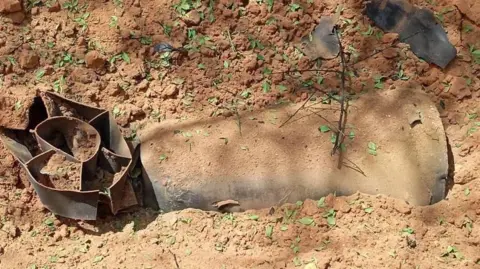
In one of these cases, Sudan Witness confirmed the existence of several videos and photos showing a crater caused by an unexploded bomb dropped by air in the Zamzam camp for displaced people in North Darfur.
 Facebook
It appears to match the SH-250 unguided munition produced by the Military Industry Company, a Sudanese arms manufacturer.
“This remains one of the most troubling findings I’ve worked on,” Snook says. “Why drop an unguided bomb on a camp for displaced people? This area was not under the control of the Rapid Support Forces at the time, and the logic behind this strike still baffles me.”
In another raid, Sudan Witness verified a rare video clip documenting the moment of impact, with the roar of an aircraft followed by several explosions while civilians were taking cover.
At least 30 people were killed and 100 others injured in a bombing in Hamra al-Sheikh market in North Kordofan state, according to reports.
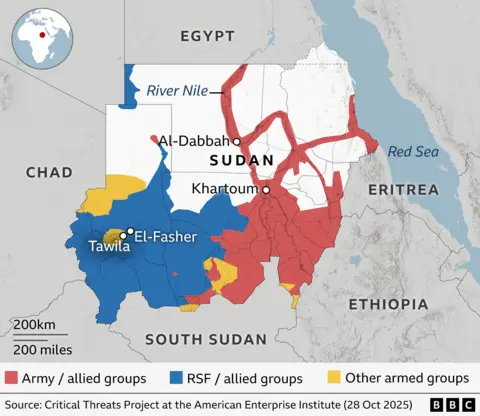
Several air attacks attributed to the Sudanese Armed Forces occurred in Darfur, which is controlled by the Rapid Support Forces.
These include an August 2024 raid on a hospital in El Daein, the historic capital of the Rizeigat people, to which the majority of the RSF belong.
The Sudan Witten website verified footage that showed damage to the building caused by shrapnel. The World Health Organization and the United Nations Children’s Fund (UNICEF) reported that 16 civilians were killed, including three children and a health care worker.
Even a rebel group allied with the army criticized the attack. The Sudan Tribune newspaper, an independent online news portal, quoted a spokesman for the Justice and Equality Movement as saying that citizens were surprised by the random air strikes that targeted hospitals and homes.
The city of Nyala in South Darfur state is a frequent target. Its airport is allegedly the main entry point for RSF weapons, including advanced drones, delivered by the UAE. Abu Dhabi denies evidence of its support for the Rapid Support Forces.
The Sudanese Armed Forces say they are targeting military supplies in the city.
But according to Sudan War Monitor, a group of researchers tracking the conflict, they lack precision weapons to strike accurately in such a crowded place.
Sudan Witness analyzed a series of air strikes on the city center carried out in February this year, which Human Rights Watch also documented. Residential neighborhoods and a grocery store near the eye hospital were bombed, killing at least 63 people.
The group says strikes on crowded markets and commercial centers not only kill civilians, but also disrupt economic stability and exacerbate the humanitarian crisis.
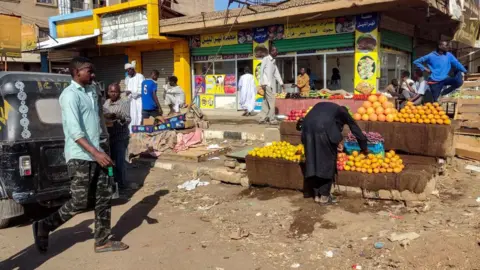
In October last year, it was reported that at least 65 people were killed and 200 others injured in a bombing that destroyed the Kuma market in North Darfur.
 AFP via Getty Images
Sudan Witten verified the location of the destroyed market footage and augmented it with satellite images showing fresh burn scars in the area.
The pile is located about 80 kilometers (50 miles) northeast of El Fasher, and until recently was the center of a fierce battle, caught in the crossfire of Sudanese Armed Forces air attacks on the Rapid Support Forces.
A local official in Dabanga told an independent Sudanese radio station, “It is impossible for the army of the state to bomb the people with its air force and claim that it is doing so to protect the country.”
Another local source said that the town had been subjected to more than 30 air strikes since the beginning of the war.
A British Foreign Office official said: “This evidence of military air strikes that hit markets and other civilian areas shows a clear and unacceptable disregard for the safety of innocent Sudanese civilians.” Whatever side of the conflict they belong to, the perpetrators of these heinous crimes must be held accountable.”
The Sudan Witness Project has continued to monitor airstrikes beyond July 2025, but says there has been a shift towards drone attacks by both sides in recent months.
The destructive cycle of air warfare sometimes targets groups seen as supporting the other side, Sudan War Monitor reported, highlighting an alleged Sudan Armed Forces drone attack on the pile in October, which this time hit a social gathering at the home of a local religious leader.
The pile is mostly inhabited by Zayadiyya, one of the Arab Bedouin groups that form the social and ethnic backbone of the RSF.
The same weekend, the Rapid Support Forces launched drone and artillery attacks on El Fasher, struck a center for religiously displaced people, and reportedly killed at least 60 civilians.
El Fasher is dominated by non-Arab groups such as the Zaghawa, who have been linked by RSF fighters to the armed Zaghawa groups defending the city.
“Neither side is using drones and air power to primarily target military sites — they are either indiscriminate or designed to terrorize civilian populations under the other side’s control, which are war crimes,” says Mr. Lynch of the Conflict Insights Group.
The Sudanese Armed Forces say the Rapid Support Forces are seeking shelter inside residential neighborhoods and insist they are strictly adhering to international humanitarian laws and rules of engagement, including the protection of civilians and their property.
Both sides of the war in Sudan were accused of committing war crimes.
This week, the Rapid Support Forces and its ally, the Sudan Liberation Movement-North (SPLM-N), were accused of launching drone strikes that hit a kindergarten and a hospital in Kalogi, South Kordofan.
The World Health Organization said 114 people were killed, including 63 children.
Mr. Lynch says that not only are civilians suffering, but that neither side has achieved military success in the air war.
He added: “The Sudanese Armed Forces used air operations to support the takeover of Khartoum, but with this exception, their use of air strikes resulted in many civilian deaths and did not achieve much military success.”
“Similarly, the Rapid Support Forces use foreign mercenaries supported by the UAE to fly drones, but with a few exceptions, have not achieved actual results.”
You can access the Sudan Watch report here When it is published on December 10.
 Getty Images/BBC
https://ichef.bbci.co.uk/news/1024/branded_news/5c19/live/e8679f70-d451-11f0-9fb5-5f3a3703a365.jpg










إرسال التعليق