











Xi and Trump find temporary truce as China plays longer game
2025-10-30 11:54:02
Laura BakerChina Correspondent
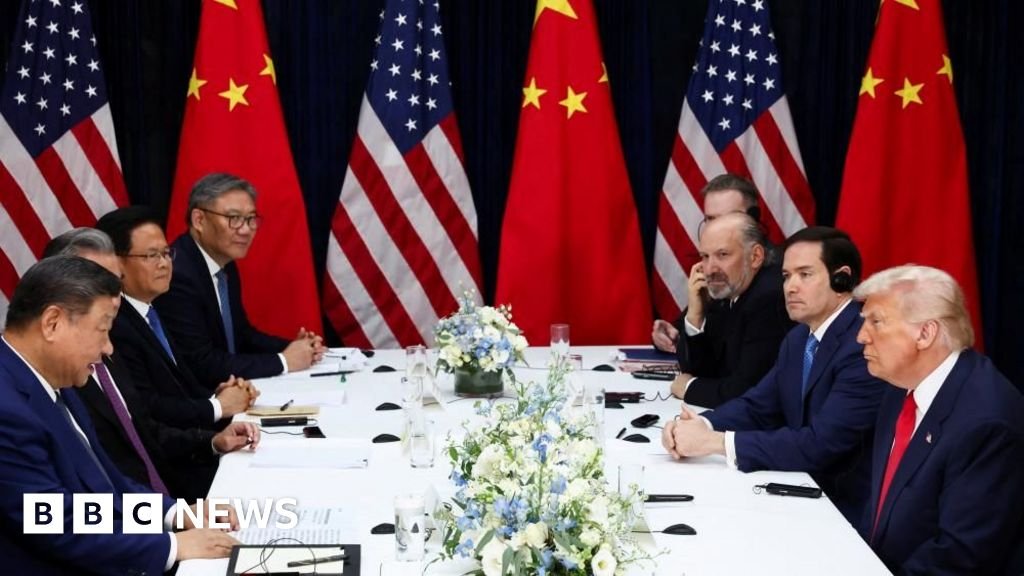
Donald Trump emerged from his meeting with Chinese leader Xi Jinping full of dazzling optimism.
He called it a “great success” and ranked it 12 on a scale of 1 to 10. China was less enthusiastic. Beijing’s initial statement reads like an instruction manual, with Xi urging teams from both sides to “follow up as soon as possible.”
Trump is seeking to reach an agreement that could happen “very soon,” while Beijing appears to want to continue the talks because it is playing a long-term game.
There was a second, more detailed Chinese statement that echoed what Trump said on Air Force One.
Among other things, the United States intends to reduce tariffs on Chinese imports, and China is suspending controls on the export of rare earth elements, extremely important minerals without which you cannot make smartphones, electric cars and, perhaps most importantly, military equipment.
An agreement has not yet been reached, and negotiators on both sides have been talking for months to hammer out the details. But Thursday’s agreement still represents a breakthrough.
It works to stabilize the relationship that has become tense between the two largest economies in the world and reassures global markets.
But it is just a temporary truce. It does not resolve the differences at the heart of this competitive relationship.
“The United States and China are going in different directions,” says Kelly Ann Shaw, who was an economic adviser to President Trump in his first term.
“It’s really about managing the disintegration in a way that does limited damage, preserves U.S. interests, and I think from China’s point of view, preserves its own interests. But that’s not a relationship that’s necessarily going to improve significantly anytime soon.”
“Strive but don’t break”
There is an art to making a deal with Donald Trump.
It involves flattery, and most countries have tried it, including during his trip to Asia so far. South Korea awarded him a huge golden crown, while the Prime Minister of Japan nominated him for the Nobel Peace Prize.
But the Chinese leader only offered to hold a meeting at an air base in South Korea, where he and Trump would meet — with one flying into the country and the other leaving.
This did not seem to contradict China’s cautious but defiant response since the beginning of Trump’s trade war. Just days after the US President increased tariffs on Chinese goods, Beijing responded with its own tariffs.
Chinese officials told the world that there would be no winners in the trade war. Like Trump, Xi also believed he had the upper hand – and appeared to have a plan.
He decided to use the country’s economic weight – as the world’s factory and a huge market for its goods – to strike back.
Unlike Trump, he does not need to worry about the election or an anxious voting base.
This does not mean that Xi does not face any pressures, he certainly does. It needs China’s economy to grow, creating jobs and wealth so that the CCP’s power is not challenged by instability or discontent.

 Getty Images
But despite the country’s current challenges – a real estate crisis, high youth unemployment, and weak consumer spending – China has shown itself willing to bear the pain of Trump’s tariffs.
The message from various ministries was that Beijing would “fight to the bitter end.”
“China’s main principle is to struggle, but not to break,” says Qiu Jin, author of The New Chinese Rules of the Game.
“It was escalated to de-escalation, which is a very new tactic.”
Shi had a plan
This means that China hit Trump where it hurts. For the first time, it limited exports of rare earth metals to the United States – China processes about 90% of the world’s rare earth metals.
“A nuance that is often overlooked in the rare earth debate is that China has an overwhelming position regarding the most strategic part of the rare earth supply chain: the heavy rare earth elements used in advanced defense systems,” says Jason Bedford, a macroeconomist and investment analyst.
“This advantage is much more difficult to displace than other parts of the rare earth industry.”
So convincing China to relax those export controls has become a priority for Washington — and was a key leverage for Xi when he sat down with Trump.
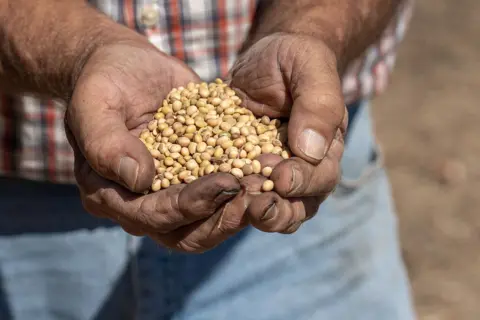
China also stopped buying US soybeans, which was targeting farmers in Republican states – Trump’s base.
Reports this week indicate that Beijing has already begun purchasing soybeans from the United States again.
“If the United States thinks it can control China, it can suppress China, and I think that has been proven wrong,” Jane says.
He added: “This is a real signal to the world, especially the United States, that China needs respect, and that it will not submit or make many political or economic concessions.”
 Getty Images
Trump’s team has found itself dealing with a stronger China than in its first term. Beijing has learned lessons, too.
It has spent the past four years searching for new trading partners and relying less on US exports – nearly a fifth of Chinese exports once went to the US, but in the first half of this year that number fell to 11%.
Xi appeared in South Korea, having formally confirmed a meeting with Trump the day before, to engage in political theater that appeared to assert a position of strength.
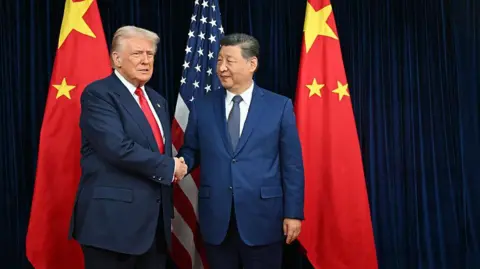
As usual, he was in front of Trump to shake hands. He stood without batting an eyelid as Trump leaned forward to whisper in his ear — the kind of loose moment that China abhors.
At the end of the meeting, Trump escorted Xi to his waiting car, where his security team immediately surrounded the Chinese leader. The US President was then forced to wander off camera to find his car on his own.
However, there are many positives to be drawn from this great power summit, the first during Trump’s second term.
“China wants to be in a position of strength when it comes to negotiations, but it will not sever the relationship, because that is not in anyone’s interest, including China,” Ms. Jin says.
For starters, companies, markets and other countries caught between competitors will welcome the calm. But observers are not sure it will last.
“I think in the medium to long term, there are very serious differences between the US and China, and I wouldn’t be surprised to see more destabilization in the next three to six months,” Ms. Xu says.
Did Trump get the bigger, better deal with China he always wanted? not yet.
Even if an agreement is achieved, and both sides put ink to paper, Beijing has now shown that it is not willing to bow to Washington — and that it is more flexible.
The rivalry between the two sides is likely to continue, if or even when an agreement is reached.
https://ichef.bbci.co.uk/news/1024/branded_news/d233/live/d92938b0-b594-11f0-aa13-0b0479f6f42a.jpg








إرسال التعليق