











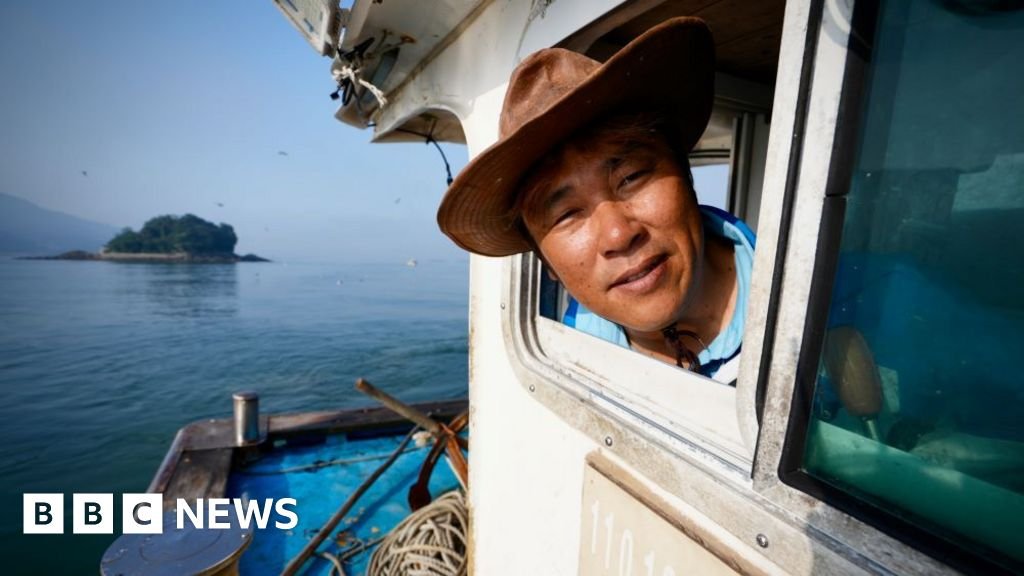
South Korea’s fishermen keep dying. Is climate change to blame?
2025-10-23 22:10:11
Jean MackenzieSeoul correspondent

 BBC/Hosoo Lee
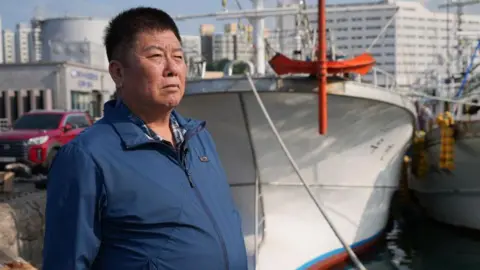
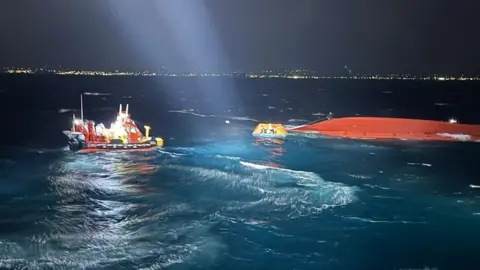
Hong Suk Hwi was waiting on the beach of Jeju Island in South Korea when the call came. His fishing boat capsized.
Only two days before, the ship had set off on what he hoped would be a long and fruitful voyage. But as the winds increased, the ship’s captain was ordered to turn back. On the way to the port, a strong wave hit from two directions, creating a vortex, and the boat capsized. Five of the ten crew members, who were sleeping in their cabins below deck, drowned.
“When I heard the news, it felt like the sky was falling,” Hong said.
Last year, 164 people were killed or went missing in accidents in the seas surrounding South Korea – a 75% jump from the previous year. Most of them were fishermen whose boats sank or capsized.
“The weather has changed, and the winds are getting stronger every year,” said Hong, who also heads the Jeju Fishing Boat Owners Association.
“The tornadoes appear suddenly. We fishermen are convinced that it is caused by climate change.”
 South Korean Coast Guard
Alarmed by the sharp rise in the number of deaths, the South Korean government launched an investigation into the incidents.
This year, the task force chair cited climate change as one of the main causes, as well as highlighting other problems – the country’s fishing workforce, increasing reliance on migrant workers, and poor safety training.
The seas surrounding Korea are warming more quickly than the global average, partly because they tend to be shallower. Between 1968 and 2024, the country’s average sea surface temperature rose by 1.58 degrees Celsius, more than double the global rise of 0.74 degrees Celsius.
Warm waters contribute to extreme weather fluctuations at sea, creating conditions for tropical storms, such as hurricanes, to become more intense.
They are also causing some fish species to migrate throughout South Korea, according to the country’s National Institute of Fisheries Science, forcing fishermen to travel farther and take greater risks to catch enough to earn a living.
Environmental activists say urgent action is needed “to stop the tragedy occurring in Korean waters.”
 BBC/Hosoo Lee
On a rainy June morning, Jeju Island’s main port was crowded with fishing boats. The crew hurried back and forth between sea and land, refueling and stocking up for their next voyage, while the boat owners paced anxiously along the dock watching the final preparations.
The boat’s owner, Kim Seung-hwan, 54, said: “I’m always afraid that something will happen to the boat. The risks have increased a lot.” “The winds have become very unpredictable and dangerous.”
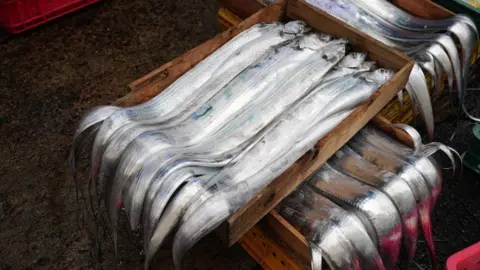
A few years ago, Kim began to notice that the popular hairy silverfish he relied on were disappearing from local waters, and his profits were falling by half.
Now his crew must journey to deeper, more dangerous waters to find them, sometimes sailing as far south as Taiwan.
“Since we work far away, it’s not always possible to come back quickly when there’s a storm warning,” he said. “If we stay close to the beach it will be safer, but to make a living we have to go far.”
 BBC/Hosoo Lee
Professor Jog Seung-ji led the investigation into the recent incidents, which found that the seas in South Korea appear to be more dangerous. She noted that the number of marine weather warnings around the Korean Peninsula – alerting fishermen of storms, storms and typhoons – rose by 65% between 2020 and 2024.
He told the BBC: “Unpredictable weather is causing more boats to capsize, especially small fishing vessels that sail further and are not designed for such long and difficult journeys.”
Professor Kim Baek-min, a climate scientist at Pukyung National University in South Korea, said that although climate change is creating conditions for an increased likelihood of strong and sudden wind gusts, a clear trend has not yet been identified – so more long-term research and data are needed.
 BBC/Hosoo Lee
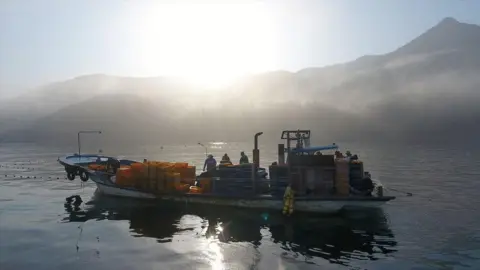
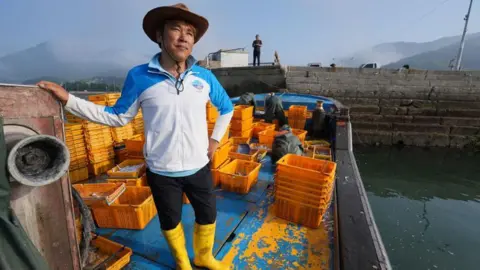
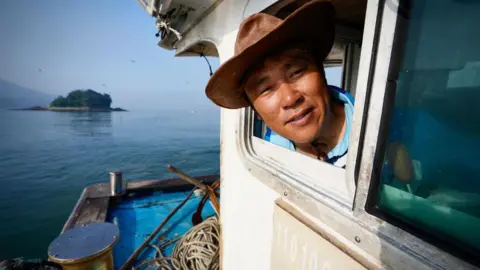
One foggy morning, we left the beach in the dark on a small fishing boat with Captain Park Hyung-il, who has been fishing for anchovies off the southern coast of Korea for more than 25 years. He sang sea shanties, determined to remain optimistic. But when we reached the nets he had left overnight, his mood collapsed.
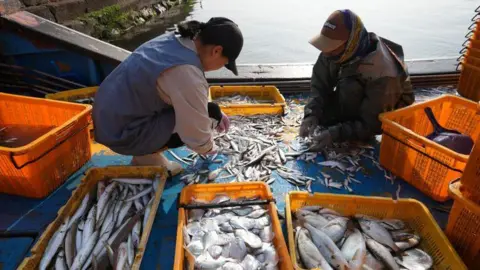
As he wound them, the anchovies could barely be seen among the hordes of jellyfish and other feed. Once the anchovies were separated, I only filled two boxes.
“In the past, we would fill 50 to 100 of these baskets in one day,” he said. “But this year the anchovies are gone and we are catching more jellyfish than fish.”
This is the predicament facing tens of thousands of fishermen along the coast of South Korea. Over the past 10 years, the amount of squid caught in South Korean waters each year has decreased by 92%, while anchovy catches have declined by 46%.
 BBC/Hosoo Lee
He added that even the anchovies Park caught were not marketable and had to be sold as animal feed.
“The load is basically worthless,” he sighed, explaining that it barely covered his daily fuel costs, let alone his crew’s wages.
“The sea is a mess, and there is no meaning anymore,” Park continued. “I used to love this job. It made me happy to know that someone, somewhere in the country, was eating the fish I caught. But now, with almost nothing to catch, that sense of pride is starting to fade.”
With livelihoods disappearing, young people are no longer willing to join the industry. In 2023, nearly half of South Korea’s fishermen were over the age of 65, compared to less than a third a decade ago.
Increasingly, elderly captains have to rely on the help of migrant workers from Vietnam and Indonesia. Often, these workers do not receive adequate safety training, and language barriers mean they cannot communicate with captains – further exacerbating the risks.
Woojin Chung, senior South Korean representative for the UK-based Environmental Justice Foundation, called it a “vicious and tragic cycle.”
When you combine extreme weather with the pressure to travel farther, the increased fuel costs that brings, and the need to rely on cheap, untrained foreign labor, she explained, “you have a greater chance of disaster.”
 BBC/Hosoo Lee
On February 9 this year, a large cargo ship suddenly sank near the coastal city of Yeosu, killing 10 crew members. It was a very cold and windy day, and small boats were forbidden from going out, but this fishing vessel was strong enough to withstand the storms. The reason for its descent remains a mystery.
Among the dead was 63-year-old Young Mok. He had been a fisherman for 40 years and was planning to retire, but that morning someone called him and asked him to fill a last-minute hole in the boat.
His daughter Ian, who is still distraught over his death, said: “It was so cold that once you fell in you would not survive hypothermia, especially at his age.”
Ian believes it has become too easy for boaters to blame climate change for accidents. Even in cases where bad weather plays a role, she believes it is still the responsibility of owners to assess risks and keep their crew safe. “Ultimately, it’s their decision on when to come out,” she said.
 BBC/Hosoo Lee
As a child, she remembers her father’s refrigerator being full of crabs and squid. “The stock is now running out, but companies are still forcing them out, and because these men have worked as fishermen all their lives, they have no alternative employment options, so they continue fishing even when they are too weak to do so,” she added.
Ian also wants owners to better maintain their boats, which are also aging. “Companies have insurance, so they are compensated after the boat sinks, but our loved ones cannot be replaced.”
Authorities realize they cannot control the weather, and are now working with fishermen to make their boats safer. As we were with Hong, whose boat capsized earlier this year, a team of government inspectors arrived to conduct a series of on-the-spot inspections on two of his other vessels.
The government task force recommended that boats be equipped with safety ladders, fishermen be required to wear life jackets, and that safety training be mandatory for all foreign crew members. It also wants to improve search and rescue operations, and enable fishermen to access local and real-time weather updates.
Some areas are even offering to pay fishermen for the jellyfish they catch, in an attempt to clean up the seas, while squid fishermen are given loans to protect them from bankruptcy and encourage them to retire.
 BBC/Hosoo Lee
Because the problem is likely to get worse. Food and Agriculture Organization of the United Nations It expects South Korea’s total fishing catch to decline by about a third by the end of this century, if carbon emissions and global warming continue on their current trajectories.
“The future looks very bleak,” said Captain Park, an anchovy fisherman, now in his late 40s. He recently started a YouTube channel to document his catches in hopes of making some extra money. Park is the third generation of his family to do this work and likely the last.
“At that time, getting up early and heading out to sea was romantic. There was a sense of adventure and reward.”
“These days it’s really hard.”
Additional reporting by Hosoo Lee and Lihyun Choi
https://ichef.bbci.co.uk/news/1024/branded_news/12fc/live/7174f7f0-a5da-11f0-928c-71dbb8619e94.jpg











إرسال التعليق