











Israel says it will return to ceasefire after Gaza strikes
2025-10-19 21:11:43
Frank GardnerBBC security correspondent, Jerusalem,
Rushdi Abu AlofGaza correspondent and
Mallory Munch

 Reuters
The Israeli military said it would resume implementing a ceasefire in Gaza after launching air strikes on Sunday in response to what it described as a “flagrant violation” by Hamas of the agreement.
The strikes began in southern Gaza after the Israeli army said that “terrorists fired an anti-tank missile and opened fire” on its forces in Rafah, killing two soldiers.
Hamas said it was “not aware” of any clashes in the area under Israeli control.
By evening, Israel said it had struck Hamas targets across Gaza, and medical sources said 44 people had been killed.
Hamas said it was committed to the ceasefire, but accused Israel of violating it and warned that the strikes could “push the situation toward complete collapse.”
Just after 21:00 local time, the IDF said it “began renewing the ceasefire,” adding that it would adhere to the agreement and “respond firmly to any violation of it.”
The statement did not directly specify whether a previous announcement suspending aid entering Gaza had been rescinded.
The first phase of the US-brokered ceasefire agreement, which began on October 10, saw an immediate end to the fighting, a partial withdrawal of Israeli forces to the so-called yellow line along northern, eastern and southern Gaza, and increased aid.
Hamas released all living hostages, as well as the remains of 12 of the 28 dead.
Israel released 250 Palestinian prisoners in its prisons and 1,718 detainees from Gaza, and returned the bodies of 15 Palestinians in exchange for the remains of every Israeli hostage.
This agreement was put to the test on Sunday when the Israeli army said that “terrorists launched an anti-tank missile and opened fire towards Israeli army forces working to dismantle terrorist infrastructure in the Rafah area in southern Gaza.”
“In response, the Israeli army began striking the area to eliminate the threat and dismantle tunnel openings and military structures used in terrorist activity.”
The military wing of Hamas denied knowledge of any clashes in the Rafah area.
The Al-Qassam Brigades said in its statement: “Contact has been cut off with the rest of our factions there since the war resumed in March of this year.
He added, “Therefore, we have nothing to do with any events taking place in those areas, and we cannot communicate with any of our fighters there, if any of them are still alive.”
Prime Minister Benjamin Netanyahu’s office said that two soldiers, Major Yaniv Kula and Sergeant Itai Yavitz, were killed in the “tragic incident in Rafah.”
The Prime Minister’s Office said earlier that he met with senior defense officials and ordered them to “act forcefully against terrorist targets in the Gaza Strip.”
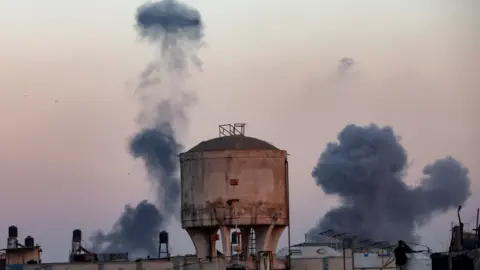
Residents living south of the nearby European Hospital said that the raids were accompanied by artillery shelling, and explosions shook parts of Rafah.
Residents also reported at least 12 air strikes in eastern Khan Yunis, as part of what people described as the “ring of fire.”
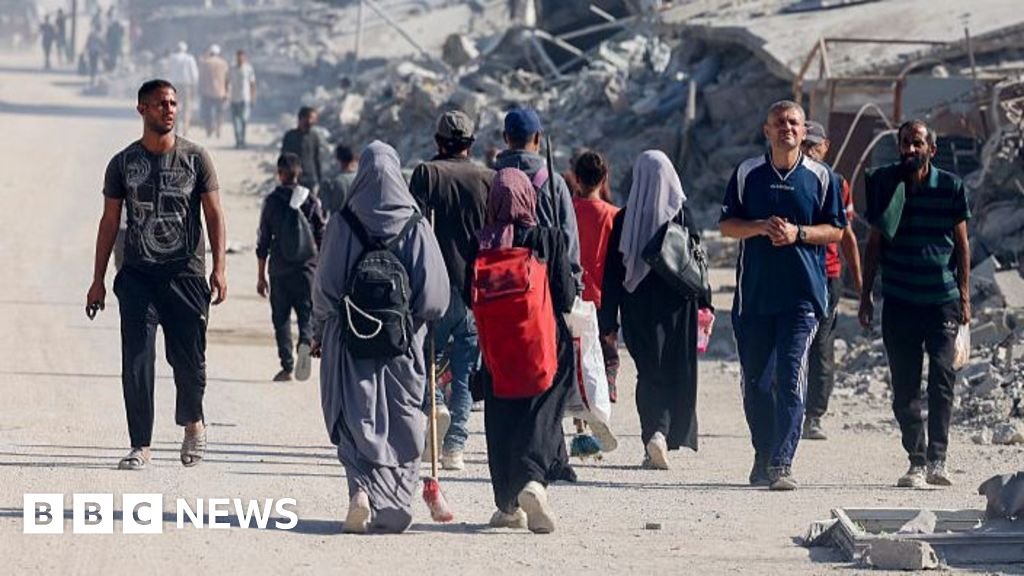
The attacks sent plumes of smoke rising over the city and caused panic among displaced families taking shelter nearby.
In central Gaza, a doctor at Al-Aqsa Hospital said that nine bodies were brought in after two separate raids hit a small seaside café, a tent in Al-Zawaida, and a building in Al-Nuseirat.
Eyewitnesses told the BBC that huge fireballs lit up the coast and strong secondary explosions echoed as ambulances and rescue workers rushed to the scene.
Local sources said that six of those killed in the Zawaida raid were members of the Al-Qassam Brigades.
Among them was Yahya al-Mabhouh, the commander of Hamas’ elite unit in the Jabalia Brigade, whose death represents one of the largest losses the movement has suffered since the start of the ceasefire.
Separately, a doctor at Al Awda Hospital in Nuseirat said that four bodies were brought in after an Israeli airstrike hit a school housing displaced families.
The doctor said that the victims included a number of women and children.
 Getty Images
Under the 20-point ceasefire agreement brokered by US President Donald Trump, Hamas is supposed to give up its weapons so that it no longer poses a threat to Israel.
Hamas, which has ruled the region for 18 years, faces a challenge from armed groups, such as the Popular Forces led by Yasser Abu Shabab, which it says is armed and supported by Israel. It says that Israel is deliberately empowering criminal gangs to challenge Hamas’ authority and cause chaos.
A local source familiar with the incident on Sunday morning told the BBC that Hamas fighters attacked a group affiliated with Abu Shabab in southeastern Rafah, an area controlled by Israeli forces.
The militants reportedly came under sudden tank fire, leading to a brief exchange of fire before Israeli warplanes bombed the site.
An Israeli military official later said that there were “at least three incidents in which Hamas opened fire on our forces standing behind the yellow line,” adding that the attacks were “not linked to any kind of internal fighting.”
IDF forces still occupy and control just over 50% of the Gaza Strip.
The strikes in Rafah came hours after the United States said it had “credible reports” that Hamas was planning an “imminent” attack on civilians in Gaza, which it said would be a “direct and serious” violation of the ceasefire agreement.
The State Department said the planned attack against the Palestinians “will undermine the significant progress achieved through mediation efforts.”
Hamas has strongly denied any imminent attack is planned.
Violent clashes broke out a week ago between Hamas security forces and armed members of the Dughmush family in Gaza City, resulting in the deaths of 27 people.
Trump previously warned Hamas against killing civilians.
“If Hamas continues to kill people in Gaza, which was not in the agreement, we will have no choice but to go in and kill them,” Trump said in a post on Truth Social earlier this week. He later clarified that he would not send American forces to Gaza.
The Israeli military launched a campaign in Gaza in response to the October 7, 2023 attack, in which Hamas-led militants killed about 1,200 people in southern Israel and took 251 others hostage.
At least 68,000 people have been killed in Israeli attacks in Gaza since then, according to the Hamas-run Health Ministry, whose figures the United Nations considers reliable.
Additional reporting by Pauline Colla
More about the war between Israel and Gaza
https://ichef.bbci.co.uk/news/1024/branded_news/d90e/live/5febcae0-ac8d-11f0-aa13-0b0479f6f42a.jpg









إرسال التعليق